


This article is Part 2A of a TechSansar series on the FY 2083/84 federal budget. Part 1 set out the full clause-by-clause reference on the tech, IT and Innovation provisions. Part 2B follows with the policy commentary that places Syuchatar in regional context.
A note on sources. At the time of writing, there is no publicly available technical specification, procurement plan, governance charter, or budget allocation document for the Sovereign AI Compute Center at Syuchatar that we could find. There is also no privately held intel available to this author. Everything in this explainer is based strictly on what appears in the FY 2083/84 federal budget speech text published by the Ministry of Finance on Jestha 15, 2083, and on publicly verifiable comparative information from other countries’ sovereign AI compute programs. Where the speech is silent, this article says so. This draft is only as good as the publicly available information; readers should treat the unanswered questions in it as the most important content.
What the budget actually says
The Sovereign AI Compute Center is announced in Clauses 56 and 57 of the FY 2083/84 budget speech. The relevant text commits the government to “establishing Nepal’s first Sovereign AI Compute Center at Syuchatar” and frames it as part of the broader digital infrastructure agenda alongside the Telecommunications Authority bill (Clause 45), the Nepal Telecom partial divestment (Clause 67), and the IT services export tax exemptions (Clause 68).
What the speech text does not specify – to the best of my knowledge:
- The total budget allocated to the center
- The targeted compute capacity (in PFLOPs, GPU count, or any other metric)
- The procurement vendor or hardware architecture
- The operator model (government-owned, public-private partnership, concession, or other)
- The access model (free-tier academic, paid commercial, hybrid, sovereign-only)
- The timeline for procurement, installation, and operational commissioning
- The owning ministry or agency, and the governance charter
- The power and cooling specifications, and whether the Nepal Electricity Authority will provide a dedicated feeder
- The relationship, if any, to the planned Telecommunications Authority or to Nepal Telecom
This is not unusual for a budget speech. Budget speeches announce political commitments; the operational specifications are normally published later by the implementing ministry. But the gap between announcement and specification is the principal subject of this explainer, because in sovereign AI compute the specification is the policy.
What “sovereign AI compute” means as a category
Sovereign AI compute is shorthand for state-controlled or state-aligned computational infrastructure dedicated to artificial intelligence workloads. The category emerged in policy discourse around 2022 and accelerated sharply after the United States imposed export controls on advanced AI chips to China and other countries in October 2022, and again with the tightened October 2023 update from the U.S. Bureau of Industry and Security.
Four motivations typically drive a country to invest in sovereign compute:
1. Data residency and national security. Training or fine-tuning on sensitive national data (military, health records, citizen identity, legal corpus) is constrained by data protection law or by political risk. Sovereign compute keeps that data within the country’s legal jurisdiction.
2. Language and cultural representation. Frontier commercial models are predominantly trained on English-language web data. Languages with smaller digital footprints (Nepali, Maithili, Newari, Bhojpuri, and the country’s other languages) get under-represented or mistranslated. A sovereign stack lets a country fine-tune or pre-train models on its own language corpora.
3. Geopolitical hedging against chip access risk. The 2022 and 2023 U.S. export controls demonstrated that compute access is a geopolitical variable, not a market commodity. Countries that depend entirely on commercial cloud providers can have their access throttled or revoked. Sovereign compute is, in part, insurance against that scenario.
4. Industrial policy. Building a domestic AI sector requires that researchers, startups, and applied teams can train and fine-tune models at scale. A subsidized national compute resource is one way to lower the barrier to entry for that ecosystem.
Each of these motivations implies a different design. Data residency drives a security-cleared, on-premises facility. Language sovereignty drives a research-grade cluster optimized for transformer training. Geopolitical hedging drives diversified chip sourcing and redundant capacity. Industrial policy drives broad subsidized access with simple onboarding.
The budget speech does not say which of these is Syuchatar’s primary purpose. That choice will determine almost everything about the facility.
The site: Syuchatar and what is publicly known
Syuchatar is a settlement in Chandragiri Municipality, Kathmandu district, roughly seven kilometres west of central Kathmandu. It sits at approximately 1,400 metres elevation. The location has been associated in public reporting with existing government technology and telecommunications infrastructure, including facilities operated by Nepal Telecom.
What is publicly known about the Syuchatar location, drawn from general infrastructure context rather than the budget speech:
The Kathmandu Valley has a long history of grid reliability challenges. The Nepal Electricity Authority’s published load-shedding archives and its present generation mix (heavily hydropower-weighted with seasonal monsoon variability) are reference points for any operator considering a 24/7 high-density compute facility in the valley. Recent years have seen substantial improvement in dry-season supply through cross-border purchase from India and from new domestic hydro coming online, but the operational reality of running a 5-20 megawatt GPU cluster at altitude in Kathmandu is materially different from running one in a tier-1 data center in Singapore, Mumbai, or Bengaluru.
The valley’s air quality also bears on data center design. Particulate matter affects HVAC filtration requirements and increases the cost of keeping a GPU cluster within its rated thermal envelope. None of this is mentioned in the budget speech, but every one of these factors is part of the real cost and feasibility picture for Syuchatar.
What a GPU cluster physically requires
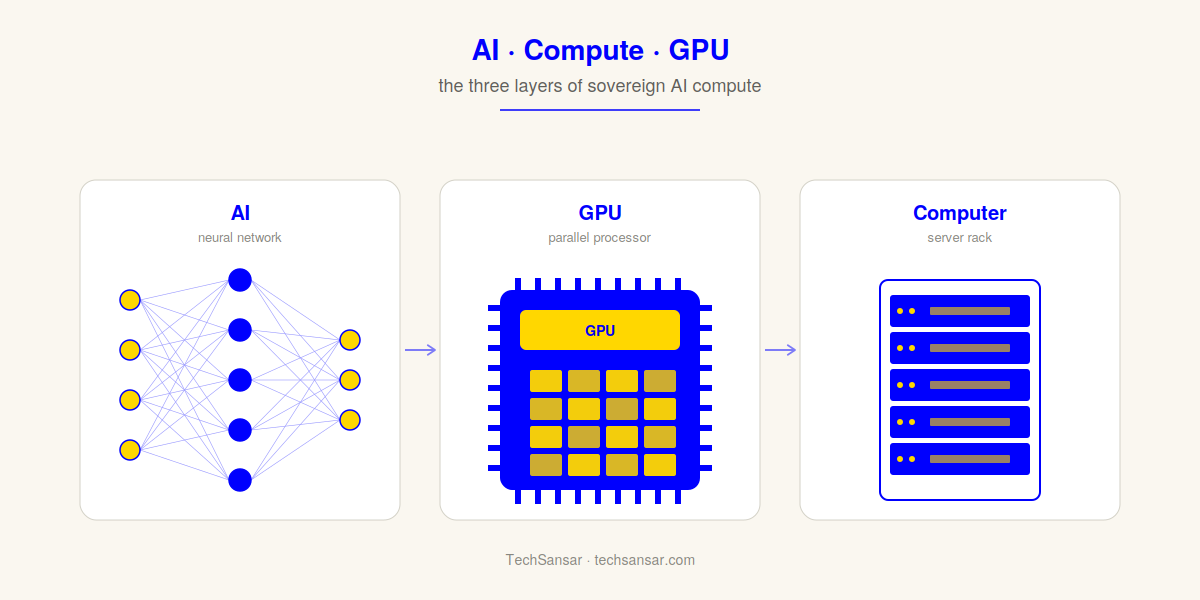
To make the discussion concrete, here is what a small-to-medium sovereign AI compute cluster looks like in physical terms. These figures are drawn from publicly disclosed specifications of comparable national programs and from NVIDIA’s reference designs published on its website.
A reference cluster of 256 modern training GPUs (for example, NVIDIA H100 or H200 class, which are the chips most national sovereign programs have procured in 2024 and 2025) consumes roughly 200-300 kilowatts of IT load at full utilization. Adding cooling, networking, storage, and supporting infrastructure typically multiplies the facility power requirement by 1.4 to 1.6 (the Uptime Institute publishes annual PUE benchmarks for the data center sector). So a 256-GPU cluster needs a facility provisioned for roughly 300-500 kilowatts of total power, with a dedicated medium-voltage feeder, redundant transformers, and either generator or large battery backup sufficient for the rated holding time.
A 1,000-GPU cluster scales these requirements roughly fourfold: 1.2-2 megawatts total facility load. India’s IndiaAI Mission, which has procured 18,693 GPUs as of its 2025 disclosures (see Part 2B), operates at a scale that requires multiple megawatts of dedicated compute power.
Beyond power, the cluster requires:
- Cooling capacity matched to the IT load. Direct-to-chip liquid cooling is now standard for new high-density training clusters because air cooling becomes uneconomical above roughly 30 kilowatts per rack.
- InfiniBand or equivalent high-speed interconnect between nodes. The interconnect is often a larger procurement line item than people expect.
- Petabyte-scale parallel file system storage (Lustre, GPFS, or VAST class) close to the compute fabric. Training a multi-billion parameter model can read tens of terabytes per epoch.
- Network egress and ingress sufficient to move training data in and model artefacts out. For a sovereign facility, this typically means redundant fibre paths to the international internet backbone, ideally via different physical routes.
- A 24/7 operations team competent in cluster management, model training, and incident response. This is the line item most commonly under-specified in announcements and most commonly under-resourced in practice.
None of this is in the budget speech for Syuchatar. The author of this article does not know, and has not been able to verify, whether any of these design decisions have been made internally by the Ministry of Communication and Information Technology or by other involved agencies. The first publicly observable signal will be a procurement notice or a tender publication.
The realistic timeline from announcement to operation
Sovereign AI compute centers do not become operational quickly. Drawing on disclosed timelines from the IndiaAI Mission, Singapore’s Foundation Model project, and Sri Lanka’s 2024-2025 compute procurement (all discussed in Part 2B), the typical sequence is:
- Months 0-3: Governance decision and operator selection
- Months 3-9: Site readiness, including power feeder commissioning and cooling installation
- Months 6-12: GPU and networking procurement, with delivery lead times that have ranged from 6 to 18 months for top-tier chips in 2024 and 2025
- Months 9-18: Installation, commissioning, and burn-in
- Months 12-24: Operational launch with limited initial workloads
- Months 18-30: Full multi-tenant operation
If Nepal moves at the pace of the better-performing programs, Syuchatar would be a functioning sovereign compute facility in 2027 or 2028 (being super hopeful here just like Gen Ziers!) If it moves at the pace of typical Nepal public infrastructure delivery, the timeline could be substantially longer. The implementation tracker published with Part 1 of this series sets the first quarter milestone as a published governance announcement; that remains the single most important early signal.
The four design questions that determine what Syuchatar becomes
The technical specification of a sovereign compute facility is not a neutral engineering choice. It expresses a policy decision about who the facility serves and what it is for. Four design questions, taken together, define almost everything that matters about the eventual operational reality of Syuchatar.
1. Who is the operator?
Operator choice is the most consequential decision and the one with the widest range of plausible outcomes. The realistic options, drawing on regional patterns, are:
- A government department or ministry (highest political control, lowest operational agility)
- A state-owned enterprise such as a reorganised Nepal Telecom or a new entity (familiar to Nepali public administration, mixed performance record)
- A public-private partnership with a domestic or regional cloud or data center operator (faster execution, more complex governance)
- A concession to an international hyperscaler with sovereignty guarantees baked into the contract (fastest operational, weakest sovereignty claim)
- An autonomous public body modeled on a research council, with an independent board and a published charter (the structure used by some of the better-performing comparator programs, but rare in Nepal)
The speech is silent on which of these the government has in mind. Is IDMC (Integrated Data Management Center) going to be one? Well, we all know what happens when a government portal is attached leading to switching off every other servers being managed, well, things apart!
2. What is the access model?
The access model determines who can actually use the compute and on what terms. The options range from a fully closed sovereign-only facility (military, intelligence, central government workloads only), through a research-priority model (universities and approved research projects get free or subsidized access, commercial use is excluded or charged), to a fully open commercial model (any registered Nepali entity can purchase compute at a published price), to a tiered hybrid (free academic tier, paid commercial tier, sovereign reserve).
The choice has direct consequences for the country’s AI ecosystem. A closed sovereign model creates no spillover to private innovation. A purely commercial model creates spillover but is rarely competitive with hyperscaler pricing. A tiered hybrid model is the structure used by IndiaAI and by Singapore’s Foundation Model project; it is also the most administratively complex to design and govern.
3. What is the procurement strategy?
GPU procurement in 2024 and 2025 has been constrained by global supply, by U.S. export controls on advanced chips, and by lead times that have at points exceeded 18 months. Sovereign programs in countries not subject to U.S. export controls have generally procured through one of three routes: direct purchase from NVIDIA via local partners, purchase via system integrators bundling compute with installation services, or hybrid purchase combining U.S.-origin and other-origin chips (with the trade-offs in software ecosystem maturity that this entails).
Nepal is not on the U.S. restricted list, so direct procurement is available in principle. The practical questions are which vendor mix, what financing structure, and what after-sales support arrangement.
4. What sits above the compute layer?
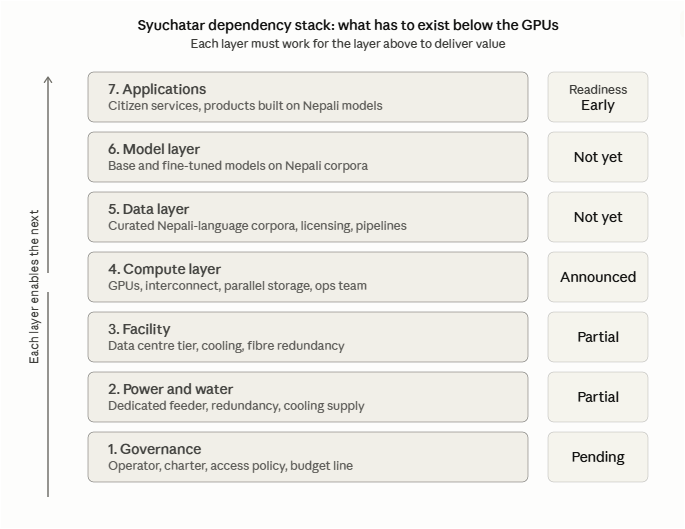
A GPU cluster is necessary but not sufficient for a sovereign AI capability. Above the compute layer sit the data layer (curated training corpora, especially in Nepal’s languages), the model layer (base models trained or fine-tuned on those corpora), and the application layer (the products and services that the models power).
Comparator programs that have built compute without simultaneously investing in the data and model layers have generally found that the compute sits idle or under-utilized. Programmes that have invested in all three layers (most clearly, India’s Bhashini language-stack program, sitting above IndiaAI’s compute) have produced more visible outputs. The budget speech mentions the compute center but does not announce a corresponding program to assemble Nepali-language training corpora or to fund model development.
What to watch for in the next two quarters
Based on the technical realities described in this article, three early public signals will indicate whether the Syuchatar project is moving from speech to specification:
1. A governance announcement naming the implementing ministry or agency, the operator, and the broad operating model. This was set as the first quarter milestone in the implementation tracker accompanying Part 1.
2. A site readiness disclosure from the Nepal Electricity Authority confirming the feeder capacity provisioned for the Syuchatar location and the cooling and water arrangements being made.
3. A procurement notice or tender document for GPU and supporting infrastructure. The procurement document, when it appears, will reveal more about the real design intent than the budget speech does.
Until those documents are public, this explainer is necessarily provisional. Part 2B, the policy commentary that follows, places the Syuchatar announcement in regional context and asks the harder question: should a country at Nepal’s stage of digital development be building sovereign AI compute at all, and if so, on what terms?
Sources and methodology
This article is based on the FY 2083/84 federal budget speech text published by the Nepal Ministry of Finance, with reference to Clauses 56 and 57 of the published text. You can find the actual budget 2083/84 speech here in Nepali and unofficial English translation here from qrsansar.com. Technical reference material for GPU cluster requirements draws on publicly disclosed specifications of comparable national programs, on NVIDIA’s published reference designs, and on the Uptime Institute’s annual PUE benchmarks. Information on U.S. export controls is sourced to the U.S. Bureau of Industry and Security.
This article is reference material and not policy advocacy. Statements that interpret the budget speech are clearly distinguishable from the speech text itself. Where this article speculates about design options, it does so explicitly and as a survey of plausible alternatives rather than as a prediction.
The author has no privileged information about the Syuchatar project, no relationship with the implementing agencies, and no commercial interest in the outcome. This is independent reference reporting based on the public record as it stood at the time of publication. Readers with corrections or additional public information are encouraged to send them to send them to us.
This article is Part 2A of a TechSansar series on Nepal Budget 2083/84. Part 1 published the full clause-by-clause reference on technology provisions. Part 2B follows immediately with the comparative policy commentary that places Syuchatar against IndiaAI, Bhashini, and other regional sovereign AI plays.



Comments 2