
You probably didn’t hear about this. There were no ribbon-cutting ceremonies, no ministerial press conferences announcing a digital revolution’s achievement. The system just launched in December 2021 and started working. Agencies signed up. Messages got delivered. Citizens received updates on vehicle registrations, court cases, and tax deadlines instead of finding out they’d missed something important.
Nepal ranks 125th on the UN E-Government Development Index, which makes this feel even more unlikely. We’re a country where “system chaldaina” is practically a national motto. Where government websites go offline during working hours, and servers turned off work-hours. Where digitization projects disappear into the same black hole as other well-intentioned initiatives. But this one stuck. This one scaled.
The gateway now handles about 13 lakh messages monthly, routing through both NTC and Ncell automatically. Agencies don’t need to negotiate with telecom providers or figure out which carrier their citizens use. It’s multi-tenant infrastructure in the unsexy but effective way—everyone shares the same pipes, and the cost per message drops as more agencies join.
The problem it’s facing now isn’t failure. It’s success. When you try to run analytics on 5.5 crore messages while the system is also delivering messages in real-time, things slow down. Information Technology Officer Prakash Dawadi put it plainly to Kantipur: “सिस्टममा तथ्यांक हेर्ने संरचना तयार भएको छैन।” The analytics infrastructure hasn’t kept pace with the messaging infrastructure.
These are growing pains, not design failures. The system that was built for a handful of pilot agencies is now supporting 149. That’s what happens when you build something people actually want to use.
So where does Nepal’s SMS gateway go from here? How does it scale from “working well” to “enterprise-grade infrastructure”? And what can we learn from countries like India and Singapore who’ve run this playbook at national scale? I spent time digging into this story, and the answers are more interesting than I expected.
Four Years of Real Impact
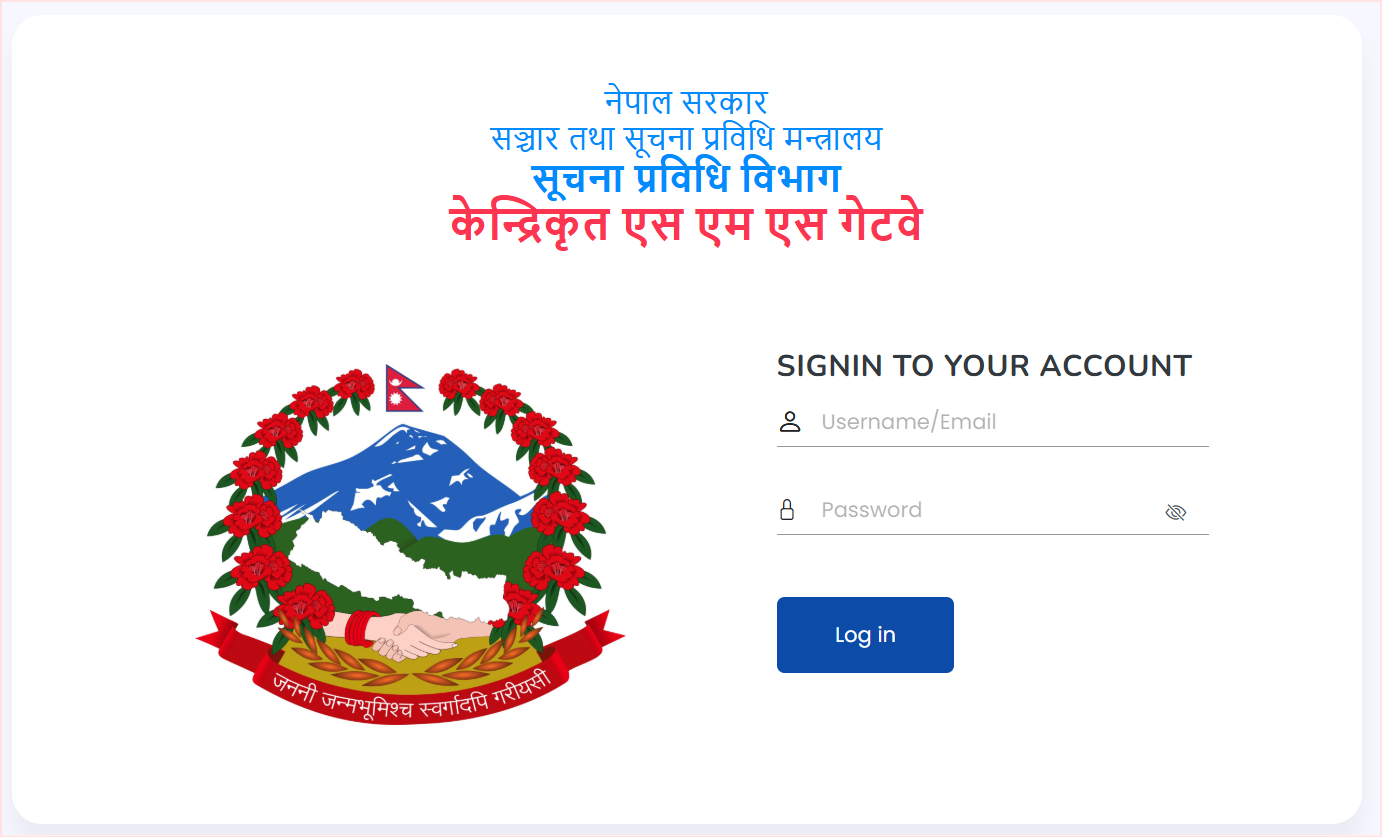
The Centralized SMS Gateway (sms.doit.gov.np) launched in Poush 2078 as a unified Application-to-Person (A2P) messaging platform. Think of it as a shared highway for government-to-citizen communication—instead of each agency building their own road, everyone uses one well-maintained expressway.
Four years in, the numbers tell their own story: 5.46 crore messages delivered, 149 agencies connected, Rs 71-98 crore saved compared to what private vendors would’ve charged. The system handles about 13 lakh messages monthly now, and the cost reduction sits at 87-90% versus commercial alternatives.
The gateway integrates with both Nepal Telecom and Ncell through direct API interconnects. It handles carrier routing automatically, which means agencies don’t worry about network coverage as the gateway figures it out. Every new agency that joins benefits from the existing investment. The per-message economics only get better with scale, which is exactly how shared infrastructure should work.
How Agencies Are Actually Using It
Numbers are one thing. Impact is another. I looked into how different agencies are using the gateway, and some examples stand out. I’m open to feedback if these observations are obscured.
The Office of the Attorney General was an early adopter. They now send 150-200 case status notifications daily to stakeholders across 97 offices—77 district government attorney offices, 18 high government attorney offices, and the Supreme Court. The result? Fewer citizens making trips to court just to ask “मेरो मुद्दाको के भयो?” because they get updates on their phones. Within two months of joining, the AG’s office had sent 10,000+ messages. That’s not trivial.
The Department of Transport Management uses it for license renewal reminders, vehicle registration alerts, and traffic violation notices. The kind of transactional messaging that saves citizens from penalties and keeps better records. No more “I didn’t know my license expired” excuses.
Then there’s the emergency use case. During the devastating floods of Asoj 2081, the Department of Hydrology and Meteorology pushed 50 lakh emergency SMS alerts in a single day through the gateway. These messages warned citizens in flood-prone areas to evacuate. When you’re talking about life-saving public communication during disasters, every paisa invested in this system starts to make a lot more sense.
At the local level, municipalities like Hetauda and Basgadhi, along with agencies in Bardiya district, are using the gateway for tax payment reminders, public service announcements, and citizen engagement. E-governance reaching the grassroots level is exactly what Nepal’s federal structure needs, and it’s happening.
Why the Economics Work
Before this gateway existed, government agencies had two choices: negotiate individual contracts with private bulk SMS providers at Rs 1.50-2.00 per message, or don’t send SMS at all. Most agencies looked at their budgets, did the math, and decided they couldn’t afford to communicate with citizens regularly. So they didn’t.
DoIT’s gateway costs 20 paisa per message, tax included. Same delivery, same carriers, one-tenth the price. Suddenly, an agency that couldn’t justify 10,000 messages at Rs 15,000-20,000 can send them for Rs 2,000. That’s the difference between silence and actually reaching people. “कम मूल्यमा सेवा उपलब्ध हुँदा सरकारी निकायले कम शुल्कमा धेरै नागरिकलाई आफ्नो सूचना पठाउन पाएको छ,” Prakash Dawadi noted. The translation is simple: affordable infrastructure means more citizens get reached.
The 87-90% cost reduction isn’t just a statistic on paper. It’s a democratization of government communication. Smaller agencies with tight budgets can now afford to keep citizens informed. That’s what shared digital infrastructure is supposed to do.
What India and Singapore Are Doing
Nepal’s gateway is part of a global trend. Governments worldwide are recognizing that citizen communication infrastructure should be shared, not fragmented. I looked at what our neighbors and leading digital nations are building—not as criticism of Nepal’s approach, but as inspiration for where we could go next.
India’s Mobile Service Delivery Gateway (MSDG), developed by C-DAC under the National e-Governance Plan, is one of the world’s largest government messaging platforms. It won the UN Public Service Award in 2014, proving this model works at massive scale.
What makes Mobile Seva particularly interesting is its multi-channel approach: SMS, USSD (for feature phones), IVRS (voice), push notifications, and mobile apps—all accessible through unified APIs. India reserved a national short code (51969) exclusively for e-governance services, integrated with all telecom operators.
The platform supports both “push” (government sends to citizens) and “pull” (citizens query information via SMS) services. Imagine a farmer in remote Humla checking land registration status by texting a simple code (this is obviously fictitious assumption as Department of Land Management and Archive hasn’t gone 100% digital thru out the country, hence not everyone can have their 11-digita LIN linked in the NagarikApps’s Malpot module). Or a citizen in Dolpa querying citizenship application progress without internet access. That’s the power of USSD and pull services. Nepal’s gateway has nailed the push piece. The next frontier could be adding bidirectional capabilities.
Singapore’s Singpass platform tells a different story – one about long-term investment. With 4.5 million users (97% of residents aged 15+), Singpass represents what happens when you run this playbook for 20 years with serious resources. What started as an authentication system evolved into a full digital identity platform with messaging built in.
The real power isn’t the app itself. It’s the infrastructure underneath. Singpass connects to Singapore’s APEX API gateway, a government-wide platform where 45+ agencies publish 2,000+ APIs. Your digital identity, tax filings, property records, health data – all accessible through authenticated APIs. Messaging becomes one service in a broader ecosystem.
Singpass runs on cloud infrastructure with near-100% uptime, handling 350 million transactions annually. That sets a concrete benchmark for Nepal: moving from “functional” to “mission-critical” reliability. From “the system usually works” to “the system is always there when citizens need it.”
As Nepal rolls out its National ID system and expands the Nagarik App, there’s a natural opportunity to integrate the SMS gateway into this broader digital identity infrastructure. Authenticated, personalized government messaging tied to your NID isn’t as far away as it might seem.
The Scaling Challenge (And Why It’s Actually Good News)
With 149 agencies onboarded and more expressing interest, Nepal’s SMS gateway is experiencing what every successful platform eventually faces: outgrowing its original architecture.
Dawadi was candid about the scaling challenges. The analytics infrastructure hasn’t kept pace with the messaging volume. When you try to run reports on 5.5 crore messages, the system slows down. This isn’t a secret, and it’s not a failure – it’s a sign that the platform has exceeded its original design parameters.
The good news? These are solved problems. The global tech community has spent decades figuring out how to scale databases, optimize queries, and build observability into large systems. Countries like Singapore run government platforms that handle hundreds of millions of transactions with near-perfect uptime. The tools and methodologies exist.
From Firefighting to Predictive Operations
The next phase for Nepal’s gateway isn’t just about “fixing slow reports.” It’s about fundamentally changing how the system is monitored and scaled. Leading tech organizations globally have moved from reactive monitoring to predictive operations. Instead of waiting for something to break, you see problems developing and prevent them.
This is where observability comes in – basically, instrumenting your system well enough that you understand what’s happening in real-time. Tools like Prometheus (for metrics collection) and Grafana (for visualization) let infrastructure teams see traffic spikes as they develop. When Dashain approaches and agencies start sending bulk reminders, the dashboard shows the load climbing. Teams can allocate additional resources before the slowdown occurs, not after users complain.
The messaging engine shouldn’t compete with the reporting engine for the same CPU and memory. The solution is a microservices architecture where these workloads are decoupled. The SMS sending service runs independently from the analytics service. Each can scale based on its own demand patterns. High traffic on reports doesn’t slow down message delivery, and vice versa.
In modern cloud-native environments, “server bigreko chha” or hardware failure is largely abstracted away. Cloud providers like AWS, Azure, and Google Cloud handle physical infrastructure redundancy automatically. When a government system slows down, the issue is almost never the hardware—it’s resource orchestration. That’s the shift Nepal’s gateway needs to make: from physical infrastructure thinking to cloud-native operations.
Aligned with Digital Nepal Framework
This isn’t just a localized technical fix. It aligns with the national vision. The Digital Nepal Framework 2.0 explicitly calls for robust digital infrastructure, the “Once Only Principle” for citizen data, and integration across government systems. The E-Governance Blueprint 2081 envisions a Data Exchange Platform where systems communicate securely with each other.
Picture this: your NID-linked vehicle registration is about to expire. The transport system automatically triggers a personalized SMS with your name, vehicle number, and a payment link. All authenticated and secure. That’s the kind of seamless, citizen-centric service Digital Nepal Framework is working toward. The SMS gateway is a building block for that future.
SMS will remain important, especially for citizens without smartphones or internet access. But the same infrastructure can evolve to support push notifications via the Nagarik App, WhatsApp Business API, Viber, and other channels. All from a unified backend. India’s Mobile Seva already does this. Nepal’s gateway could too.
A Direct Appeal to Government Agencies
If your agency isn’t using the centralized SMS gateway yet, here’s why you should reconsider.
You’re paying 8-10 times more than you need to for the exact same service. You’re negotiating contracts, managing technical integrations, and dealing with vendor relationships – all of which DoIT has already solved. And you’re doing it alone instead of joining 149 other agencies who’ve figured out that shared infrastructure just makes sense.
The onboarding is straightforward. The cost savings are immediate. And every message you send through the system strengthens the case for more investment in digital public infrastructure. That’s not patriotic fluff—it’s how network effects actually work. The more agencies join, the stronger the economic and political case becomes for continued investment and scaling.
DoIT can help you get started. The contact information is available through their website. The only real question is what you’re waiting for.
Taking Stock: What We’ve Actually Built
Four years. 5.5 crore messages. 149 agencies. Rs 71-98 crore saved. In a country where “system bigrekochha” or “internet chhaina” is practically a national motto, the Department of IT built something that works—and keeps working.
The gateway delivered life-saving flood alerts in Asoj 2081. It sends license renewal reminders that save citizens penalty fees. It updates litigants on their cases so they don’t have to make unnecessary court visits. These aren’t headline-grabbing innovations, but they’re the quiet infrastructure that makes government actually function.
Yes, the system needs scaling. The analytics are slow when handling the full dataset. The next phase requires investment in cloud architecture and observability tools. But that’s what success looks like in infrastructure—you build something people actually use, and then you deal with the growing pains. That’s a problem worth having.
India’s Mobile Seva didn’t win UN awards on day one. Singapore’s Singpass evolved over two decades. Nepal’s gateway is four years in, with a strong foundation and clear momentum.
What Comes Next
The vision is clear: a future where government communication is seamless, affordable, and citizen-centric. Where “server bigreko chha” becomes a relic of the past, replaced by systems that scale gracefully and predict problems before they happen. Where every Nepali citizen, from Kathmandu to Karnali, can receive timely, authenticated information from their government.
The foundation exists. The agencies are using it. The savings are real. The next chapter is about scaling it properly—moving from “functional shared infrastructure” to “enterprise-grade digital public goods.”
With continued commitment and smart investment in cloud-native architecture, observability, and integration with broader digital identity systems, Nepal’s SMS gateway could become a model for digital public infrastructure across South Asia.
We at TechSansar will be watching closely as this system evolves. Because when government technology actually works in Nepal, that’s a story worth telling and celebrating.
The story isn’t over. It’s just getting started.
References & Further Reading
1. Primary Source: Kantipur Daily, “सरकारी निकायले पठाए चार वर्षमा साढे ५ करोड एसएमएस” (Poush 2081) पुस ३, २०८२ by सजना बराल
2. India Mobile Seva: mgov.gov.in
3. Singapore Singpass: developer.tech.gov.sg/products/categories/digital-identity/singpass/overview
4. Digital Nepal Framework: mocit.gov.np
5. E-Governance Blueprint 2081: opmcm.gov.np (E-Governance Board)
6. UN E-Government Survey 2022: publicadministration.un.org/egovkb
7. World Bank – Singapore NDI Case Study: blogs.worldbank.org/digital-development
Related on TechSansar:
• Practical e-Government scenario in Nepal: techsansar.com/nepali-it/practical-egovernment-scenario-nepal/
• Government Cloud comes to Nepal: techsansar.com/nepali-it/nepal-government-cloud/
• Nepal adopts Digital Signature: techsansar.com/computing/nepal-adopts-digital-signature/
• Progress and Challenges of ICT4D in Nepal: techsansar.com/application/progress-challenges-ict-development-ict4d-nepal/
• Nepal’s ICT Policy 2015: techsansar.com/ict/nepal-ict-policy-2015/
Cite this article
Ekendra Lamsal. (2025). Nepal's Department of IT saved Rs 98 crore with centralized A2P messaging: A GovTech success story. TechSansar. https://techsansar.com/nepali-it/nepal-doit-sms-govtech-story/