The global software development landscape is undergoing a profound transformation with the rise of AI coding assistants – and see this is not going to stop sometimes soon. As these tools become increasingly sophisticated in 2025, Nepalese developers and tech companies face both unprecedented opportunities and significant challenges. This evolution comes at a crucial time for Nepal’s IT sector, which has emerged as a significant contributor to the nation’s economy through remote work and digital exports.
Nepal’s software developers working remotely for international companies are now earning substantial salaries, often ranging in lakhs monthly, with experienced specialists commanding even higher figures and more flexible work style unlike the traditional Nepalese work culture. According to Payscale data, mid-level software engineers with 5-9 years of experience can earn around NPR 1,320,000 annually through opportunities with international clients. These earnings have turned the IT sector into a major source of foreign currency for Nepal, with the country’s IT service exports reaching an impressive USD 515.4 million in 2022 according to the Confederation of Nepalese Industries (CNI), surpassing even traditional tourism revenue.
This analysis explores how AI-powered development tools are reshaping Nepal’s growing tech ecosystem and highlights how both local companies and techpreneurs are adapting to this technological revolution, with special attention to how these changes might affect the profitable remote work market that has helped many Nepalese developers achieve financial success while remaining in their home country. And this is all evident.
Understanding AI Coding Assistants
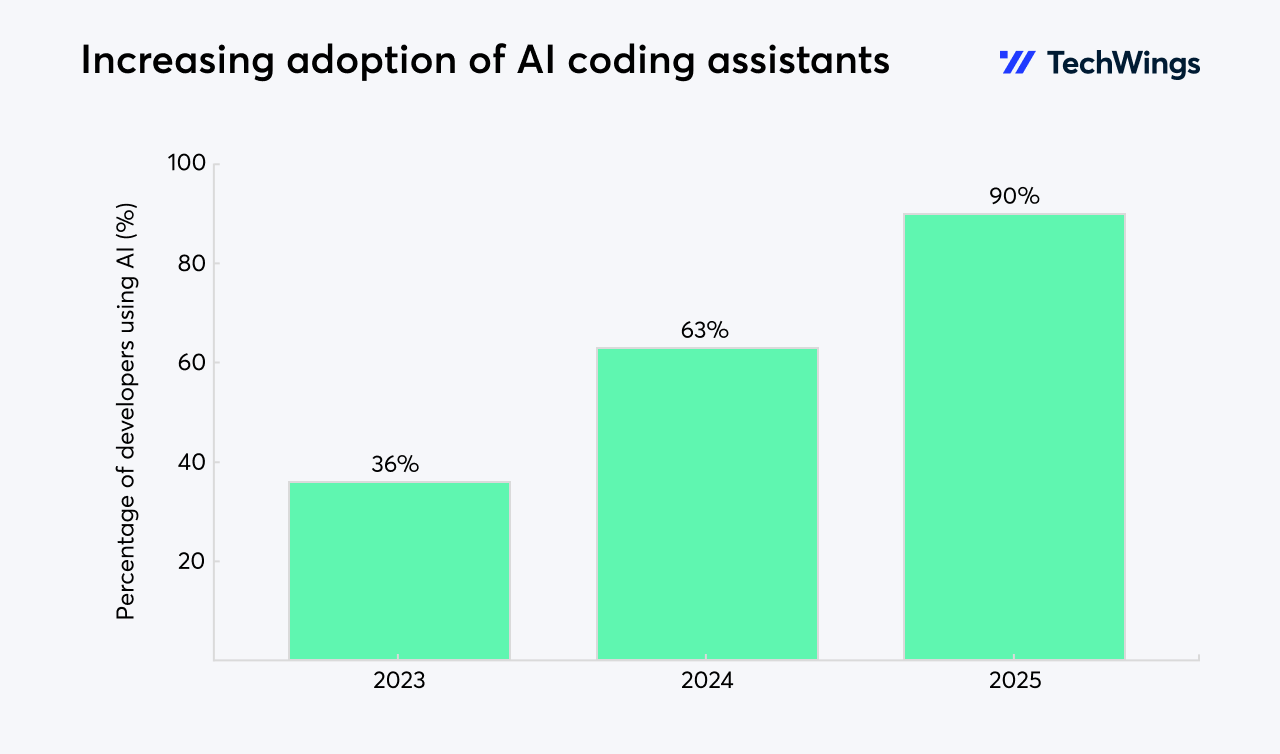
AI coding assistants have evolved from simple code completion tools to sophisticated platforms capable of generating entire code blocks, debugging, optimizing code, and even explaining complex codebases. Tools like GitHub Copilot, Amazon Q Developer, and Tabnine have demonstrated impressive capabilities in enhancing developer productivity.
Recent studies suggest that developers using AI coding assistants can complete 26% more tasks on average, with code volume increasing by 13.5% and compilation frequency rising by 38.4%. These productivity gains come without sacrificing code quality, making AI tools increasingly attractive for businesses looking to optimize their development processes.
The Nepali AI and Tech Landscape
Nepal’s tech industry has been growing steadily over the past decade, with several companies now at the forefront of AI innovation and implementation. What makes this growth particularly remarkable is that most Nepali IT companies have built their success by serving international clients, positioning Nepal as an emerging outsourcing destination in the global tech ecosystem. The IT outsourcing sector in Nepal is projected to reach US$106.42 million by 2025, according to Statista forecasts, showcasing the country’s growing significance in the global tech landscape.
Understanding this landscape is crucial to assessing how AI coding assistants might impact local developers who have found profitable opportunities working remotely for companies in the US, Europe, and Australia.
To stay competitive, Nepali developers should actively seek AI tool training, specialize in AI integration skills, and engage in local tech communities like AI Developers Nepal.
Fusemachines Nepal: Democratizing AI
Fusemachines Nepal, established in 2013, has positioned itself as the country’s leading AI-focused company. With over 500 software engineers, the company has been instrumental in “democratizing AI” across various sectors in Nepal and globally. Their AI Fellowship program has trained more than 700 fellows in machine learning, deep learning, computer vision, and natural language processing, significantly contributing to the growth of AI expertise in the country.
“Fusemachines are the industry leaders at transforming enterprises through AI. And also help their clients get started at their AI journey of their own,” notes one industry report, highlighting the company’s role in building Nepal’s AI capabilities .
The company provides AI solutions across healthcare, retail, finance, human resources, media, and entertainment sectors, demonstrating the wide-ranging impact of artificial intelligence on Nepal’s digital ecosystem. By investing in education and talent development, Fusemachines is helping prepare Nepali developers for a future where AI and human programmers work collaboratively.
Paaila Technology: Homegrown Innovation
Paaila Technology represents Nepal’s innovative spirit in the AI space. Founded in 2016 by graduates of Pulchowk Engineering Campus, the company specializes in robotics and AI, developing robots like “Pari” and “Ginger” that have gained international attention.
Paaila’s work demonstrates how Nepali companies can develop advanced AI systems with local talent. Their service robots deployed in banks and restaurants showcase practical applications of AI in everyday business settings. The company’s innovations in Nepali speech recognition, natural language processing, and computer vision directly relate to the technologies powering modern AI coding assistants.
“Paaila Technology was awarded with Best Startup, Nepal (2017) and Most Creative Business, Nepal (2018) and took part in global competition for startups Creative Business Cup (2018) in Denmark,” highlighting the international recognition of Nepali AI innovation .
iBriz.ai: Bridging AI and Blockchain
iBriz.ai has carved a unique niche by combining expertise in both AI and blockchain technologies. Based in Kathmandu but serving clients globally, the company specializes in AI recruitment, outsourcing, and consulting services. iBriz.ai has established an extensive network of AI/ML and data science talent that helps companies around the world implement AI strategies and solutions.
The company exemplifies the global orientation of Nepal’s tech sector, with services specifically designed to bridge knowledge and talent gaps between Nepal and international markets. Their specialization in both emerging technologies positions them at the intersection of two transformative fields that are reshaping software development.
Wise Yak: Healthcare AI Innovation
Wise Yak Inc. represents another specialized AI success story from Nepal, operating from bases in both Bellevue, Washington and Kathmandu. The company focuses on applying AI and machine learning to healthcare challenges, with a mission to make quality healthcare accessible globally.
With a team of over 30 software engineers specializing in machine learning, health technology, natural language processing, and patient-centered design thinking, Wise Yak has developed healthcare data platforms and AI-driven diagnostic tools. Their international footprint, with operations in both the US and Nepal, demonstrates how Nepali AI expertise is increasingly recognized and valued in global markets.
F1Soft International: Fintech Innovation
While not primarily an AI company, F1Soft International represents how established Nepali tech firms are incorporating advanced technologies into their products. As Nepal’s leading fintech company founded in 2004, F1Soft has been instrumental in digitalizing the country’s financial infrastructure through platforms like eSewa and Fonepay – and at the same time inspiring fellow companies to adapt tech.
The company’s development of sophisticated digital payment systems and banking solutions demonstrates the high level of technical expertise present in Nepal’s developer community. F1Soft regularly hosts events like the “Bankers’ Meetup” to discuss emerging technologies, including AI’s role in financial services, showing how established tech companies are embracing new development paradigms.
Opportunities for Nepalese Developers
Productivity Enhancement and Global Competitiveness
AI coding assistants could level the playing field for Nepali developers competing in global markets. With tools handling routine coding tasks, local developers can deliver projects more quickly and focus on building domain expertise rather than writing boilerplate code.
The financial implications are significant. Remote Nepali software developers already earn competitive salaries averaging USD 40,700 annually according to Arc Developer data. This remote work market has created a powerful economic engine, with many developers earning in lakhs (hundreds of thousands) of rupees monthly while working for international clients. AI-enhanced productivity could further boost these earnings by allowing developers to handle more projects or tackle more complex work that commands premium rates.
Companies like Leapfrog Technology, which has been working on digital transformation since 2010, could significantly increase their development velocity with AI assistance. For a company that has already completed 200+ projects and works with clients globally, AI coding tools provide an opportunity to scale operations and take on more complex projects.
Specialized Skill Development
As routine coding becomes increasingly automated, there’s growing demand for developers who can effectively leverage AI tools. This shift creates opportunities for Nepali developers to specialize in:
- Prompt engineering: Crafting effective instructions for AI models
- AI integration: Combining AI capabilities with human expertise
- System architecture: Designing complex systems that utilize AI components
- Domain expertise: Applying industry-specific knowledge to guide AI development
The AI Fellowship program at Fusemachines demonstrates how Nepali developers are already preparing for this future, gaining specialized skills that command premium rates in the global market.
Accessibility and Inclusion
AI coding assistants lower the barrier to entry for non-traditional developers. This democratization could help address Nepal’s tech talent shortage by enabling more people to contribute to software development, even without extensive formal training.
For a country with limited educational resources in some regions, this inclusivity represents a significant opportunity to expand the developer pool beyond urban centers like Kathmandu and Pokhara.
Government and educational institutions must proactively support curriculum updates to equip the workforce adequately for an AI-driven economy.
Challenges for Nepal’s Tech Ecosystem
Employment Restructuring
The increasing efficiency of AI-assisted development may lead to restructuring within development teams. Industry experts suggest that companies might hire fewer junior developers as AI takes over routine coding tasks. This could affect entry-level opportunities in Nepal’s tech industry, potentially altering traditional career progression paths.
For a country where IT outsourcing has been a significant source of employment, this shift requires careful navigation to ensure continued growth in tech jobs.
Skill Dependency
Over-reliance on AI tools could potentially erode fundamental coding skills. Developers who become too dependent on AI suggestions might struggle with deeper problem-solving or understanding the underlying principles of the code they’re implementing.
Educational institutions like Pulchowk Engineering Campus, which has produced successful founders of companies like Paaila Technology, will need to adapt their curricula to balance AI tool usage with fundamental programming concepts.
Economic Implications
If global companies can accomplish more with fewer developers using AI tools, this could affect Nepal’s growing outsourcing industry. However, companies that specialize in higher-value services, like Leapfrog Technology and Fusemachines, may be better positioned to navigate this transition by focusing on complex problem-solving and domain expertise.
Preparing for an AI-Enhanced Future
For Nepal’s tech industry to thrive in this evolving landscape, several adaptations will be necessary:
Education and Training Reform
Educational institutions and bootcamps need to update their curricula to focus less on syntax and basic coding patterns (which AI can now handle) and more on architecture, system design, AI prompt engineering, and business domain knowledge.
Initiatives like Nepal’s International AI Conference 2024, which focused on “policy making, ethics, and digitization” ., demonstrate growing awareness of the need for AI-focused education.
Specialization in High-Value Areas
Nepali developers should consider specializing in areas where human expertise remains essential – such as complex problem-solving, ethical considerations, user experience design, and industry-specific applications.
Paaila Technology’s success demonstrates how specialized knowledge in robotics and AI has created unique market opportunities that wouldn’t exist with general software development skills alone.
Community Building and Knowledge Sharing
Organizations like AI Developers Nepal are already creating communities focused on AI advancement. Their AI Saturdays workshops, which bring together everyone from complete beginners to experienced AI practitioners, help disseminate knowledge about artificial intelligence technologies .
Expanding these initiatives to include training on effective AI tool usage could help Nepali developers stay competitive in a rapidly evolving field.
The Path Forward: Nepal’s AI-Enabled Development Future
Rather than viewing AI coding assistants as competitors, Nepal’s tech community should embrace them as powerful tools that can enhance human capabilities. By integrating these technologies effectively, Nepali developers can focus on higher-value work while leveraging AI to handle routine tasks.
The economic stakes are significant. Nepal’s IT service exports have grown dramatically, reaching USD 515.4 million in 2022, becoming one of the country’s most valuable foreign currency sources. This growth has been driven largely by remote work opportunities, with the pandemic accelerating the trend toward online freelancing and remote employment with international companies. Maintaining this momentum while adapting to AI tools will be crucial for the sector’s continued contribution to Nepal’s economy.
Fusemachines’ approach provides a template for this integration. By investing in AI education while simultaneously providing AI services, they’ve created a sustainable model for AI adoption that benefits both their business and the broader tech ecosystem.
The most successful developers will be those who learn to “pair program” with AI – using the technology to amplify their creativity and problem-solving abilities rather than replace them. This collaborative approach could position Nepal’s tech industry for substantial growth in the global digital economy.
Companies like F1Soft International exemplify how established tech firms can evolve with new technologies. Their continual innovation in digital financial services shows how Nepali companies can maintain leadership positions by embracing technological change.
Conclusion
AI coding assistants represent both a challenge and an opportunity for Nepal’s software development community. By embracing these tools while focusing on developing complementary human skills, Nepali developers can ride the wave of AI transformation rather than being swept away by it.
The success stories of companies like Fusemachines, Paaila Technology, and F1Soft International demonstrate that Nepal has the talent and vision to thrive in an AI-augmented future. By building on these foundations and adapting to changing technological paradigms, Nepal’s tech industry can continue its upward trajectory in the global digital economy.
The future belongs not to those who code the fastest, but to those who can most effectively collaborate with AI to solve meaningful problems. With the right approach, Nepal’s developers can be at the forefront of this collaborative revolution.
This article was originally published on July 4, 2025 by TechSansar.com. For more insights into tech trends affecting Nepal’s digital ecosystem, visit our Technology section.