Standalone analysis. Related TechSansar coverage: the Syuchatar technical explainer and the Syuchatar policy commentary.
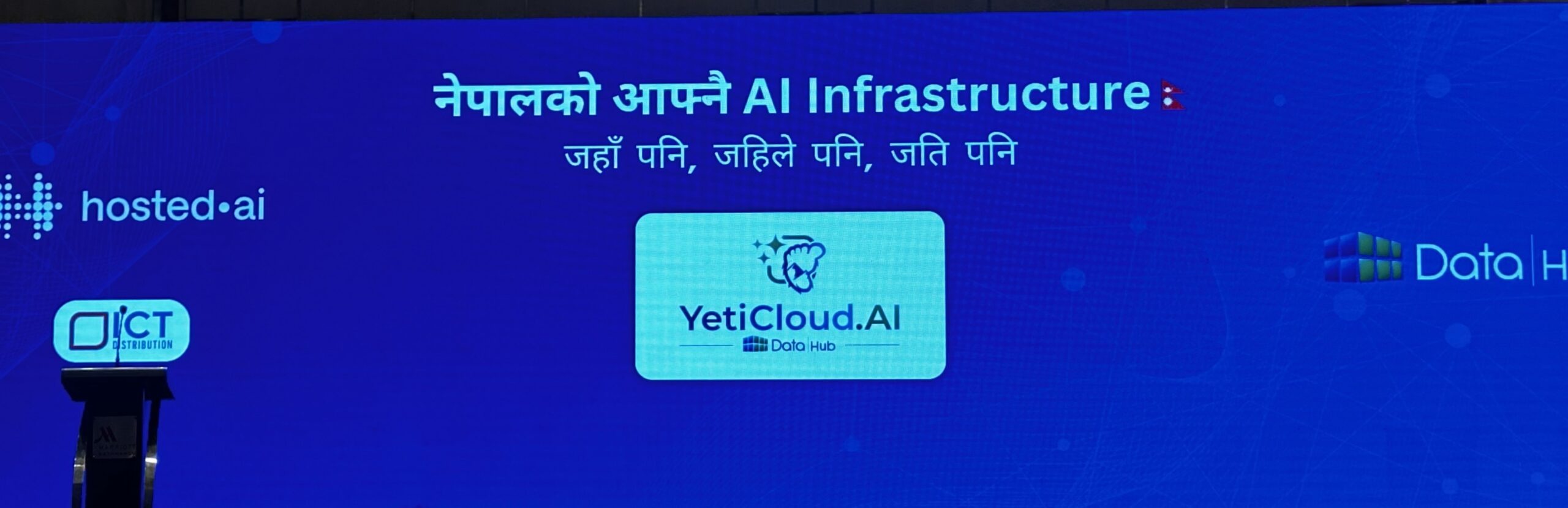
For five weeks, Nepal’s sovereign AI compute debate has been an argument about the state: whether the government should build the Sovereign AI Compute Center it announced at Syuchatar in two clauses of the FY 2083/84 budget, whether it can, and what it would cost a country that rations electricity every winter. On July 3, 2026, a private company walked past the whole argument. DataHub launched YetiCloud.AI at Hotel Marriott, Kathmandu, billing it as Nepal’s first GPU-as-a-Service platform under the tagline “नेपालको आफ्नै AI Infrastructure: जहाँ पनि, जहिले पनि, जति पनि” (Nepal’s own AI infrastructure: anywhere, anytime, as much as you need). And the government did not just attend. It sat on the launch panel, and what it said there quietly rewrote the Syuchatar story this publication has been covering since budget day.
Disclosure and source limitation. Team TechSansar attended the YetiCloud.AI launch on DataHub’s invitation. No payment or editorial condition was attached, and DataHub did not review this article before publication. Panel remarks were delivered partly in Nepali; quotations from the panel are translated and lightly edited for clarity, and speakers were not offered quote review. DataHub disclosed no GPU model, GPU count, rate card, or capacity figure at the launch, and none appears on its public pages at the time of writing. Pricing claims quoted below are the company’s and its partner’s assertions, not verified rates. Figures cited from the keynote (power curtailment values, export statistics, Bhutan mining estimates) are the speaker’s and are flagged where we could not independently verify them.
What the record said before July 3
The FY 2083/84 budget, presented on Jestha 15, 2083 (May 29, 2026), committed the government to a Sovereign AI Compute Center at Syuchatar in two clauses, with no specification, no line-item allocation, no timeline, and no named operator. Our technical explainer walked through what such a facility physically requires, and our policy commentary argued that the announcement’s silence on governance was the real story. Between budget day and the launch, nothing material was added to the public record.
The commentary space was not empty, though. In May, the Kathmandu Post ran a pair of pieces that anticipated both sides of this story: Sameer Maskey’s case for a sovereign AI factory, which the launch keynote would later quote from the stage, and a more skeptical examination of whether Nepal is ready for data centers at all. The launch is best read as the first hard evidence entering that argument. The launch changed that in both directions: a private product now exists, and the government has spoken.
What the launch said
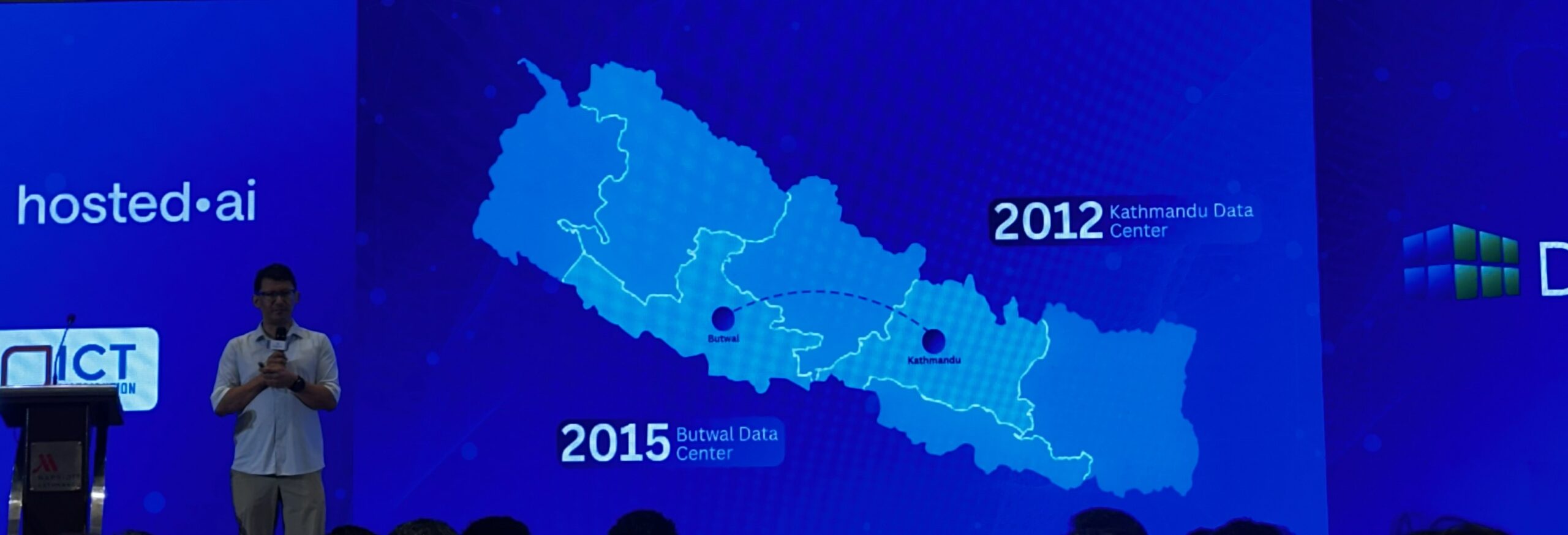
The company’s own case came from Deepak Shrestha, Managing Director of DataHub Pvt. Ltd. His presentation grounded the launch in the company’s history rather than the AI moment: DataHub has operated a Kathmandu data center since 2012 and a Butwal facility since 2015, per the timeline he presented, which makes YetiCloud.AI an infrastructure operator’s product extension rather than a startup’s promise. His positioning of the platform was unambiguous: “Enterprise-grade GPU infrastructure… Nepal’s first sovereign AI cloud,” offering “powerful NVIDIA GPUs hosted right here in Kathmandu” for customers to “train models, deploy LLMs, run inference, and accelerate research without expensive hardware imports or foreign cloud latency,” built, in his words, for Nepali businesses, researchers, and developers. Note what that confirms and what it does not: the GPUs sit in the Kathmandu facility, and the pitch explicitly includes training, not just inference. Hold that thought; the keynote that followed quietly walked it back.
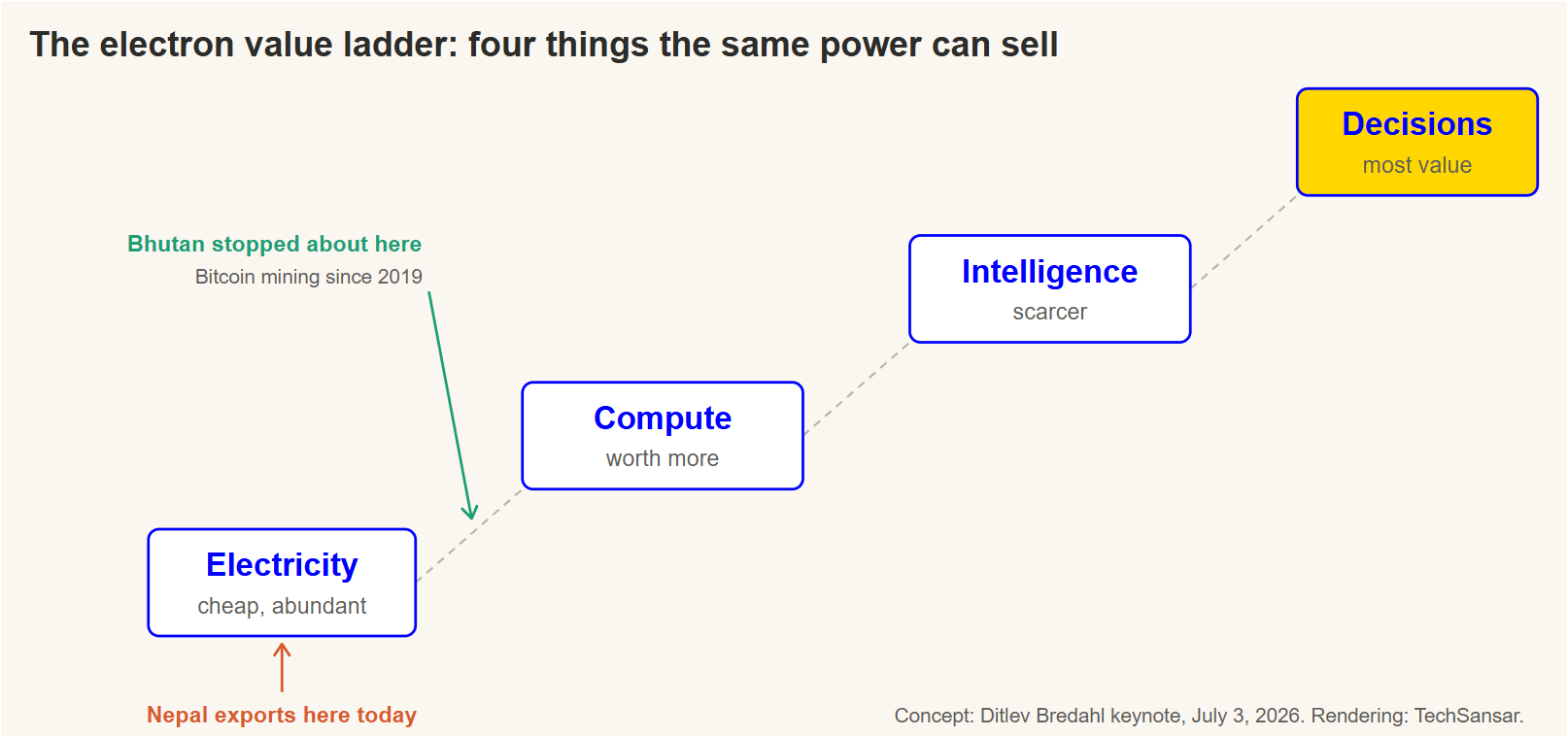
The keynote came from Ditlev Bredahl, CEO and co-founder of Hosted.ai, whose platform sits behind YetiCloud.AI, alongside Packet.ai and GPUaaS.com. (The commercial structure between DataHub and Hosted.ai platform license, revenue share, or joint venture was not specified on stage.) His core frame was a four-step value ladder: the same electron can be sold as electricity, as compute, as intelligence, or as decisions, and each step up is worth more. “Today, you are exporting the electricity, and you are leaving the compute, the intelligence, and the decisions for other people,” he told the room. “The export shouldn’t be the electron. The export should be what the electron produces.”
He put a number on the waste. Citing a report he said he had found that morning, Bredahl claimed that in 2025 roughly 192 million dollars of Nepali generation was curtailed: water through the turbines with no buyer, India unable to absorb it, Nepal unable to use it. The reference matches recent reporting: two days before the launch, the Kathmandu Post reported NEA directing hydropower projects to cut output amid monsoon surplus and transmission constraints, and IPPAN has put a value on energy curtailed in FY 2081/82. A definitional note applies: curtailment here means output NEA ordered reduced or could not evacuate, which is not identical to energy literally spilled unpaid, and the dollar value depends on which tariff you price it at. Bredahl’s back-of-envelope equivalence, that the lost power could run “a million V100s,” is directionally sound: a million such GPUs draw roughly 250 to 300 megawatts continuously, which at Nepal’s export tariffs is indeed in the neighborhood of his figure. The number is doing rhetorical work for his industry, but the seasonal pattern beneath it is documented and familiar to every reader of this site : surplus in the wet season, imports and shortfall in winter.
He closed the sovereignty argument by invoking a May 2026 Kathmandu Post op-ed by Sameer Maskey, “Why Nepal must build a sovereign AI factory”: without its own compute, Nepal stays a digital colony. Two claims deserve to be quoted precisely because the article will hold the company to them.
On price: YetiCloud.AI will be “certainly cheaper than US clouds and most likely cheaper than any other location in the world.”
On support: “When you call someone, it will be someone sitting here in Kathmandu… someone who understands the local problem, the local language.”
And one concession deserves equal prominence, because it is the honest version of the winter question this publication keeps asking: “It’s probably also not 99.99 uptime,” Bredahl acknowledged, arguing that Nepal-ready data centers must be engineered for earthquakes and power interruption, and that the sane starting point is small: You don’t have to start with a cluster of a hundred nodes.
The company’s pitch says “train models”; the keynote’s advice was to start with “five or ten GPUs” and grow. Both cannot be the headline truth at once: that is a sensible inference and fine-tuning business wearing a training platform’s tagline, and until a spec sheet and rate card exist, the gap between the two statements is the most informative disclosure of the night. Megawatt-scale inference, not gigawatt-scale training. That is a materially more modest, and more credible, positioning than the launch branding suggests.
The government blinked first
The panel is where the news happened. Moderated by Ananda Raj Khanal, chair of Nepal Digital Leads and a former senior director at the NTA, it put Subash Dhakal, Director General of the Department of Information Technology (DoIT), on stage at a private GPU cloud launch five weeks after the budget promised a state compute center. His remarks are the government’s first substantive public positioning on sovereign compute since budget day, and three of them matter.
First, the posture. “The government is not in the mindset of competing with the private sector,” Dhakal said (translated). “The government aims to be an enabler, to act as a catalyst.” Asked directly whether the state would build and operate AI infrastructure in competition with services like YetiCloud.AI, he described the roles as complementary and distinct; and the government can actually learn and get support from the private sector.
Second, and this is the finding that changes our prior coverage: Syuchatar is not fixed. “Let’s not focus on the specific location,” Dhakal said of the budget’s named site. “The Syuchatar location might be a hub, or there could be another hub for the data center. Syuchatar likely has slightly better infrastructure, but alternative locations are also possible.” Both of our earlier articles analyzed Syuchatar as a settled siting decision, including the power-infrastructure logic of the location. The chief of Government’s IT department has now made the site provisional, on the record. Readers of our policy commentary should treat its siting analysis as conditional until a formal project document names a location.
Third, an actual roadmap, which the budget never contained. Dhakal described a classification exercise sorting government systems and data into critical and non-critical tiers: high-critical systems stay in the government’s own data center, and everything else can be opened to private facilities. The gate is certification, and here he made a genuinely interesting admission: international data center certification is too costly for Nepali operators, so the ministry is studying local audit standards with local verification as the qualifying route. “This roadmap might take about six to nine months to execute if things go smoothly,” he said. He also drew a line few in the room expected: non-transactional, anonymized data should be open for AI research as a matter of policy, and if researchers cannot wait for the coming data governance law, “I can explore an executive order to help make that data accessible for AI research and innovation.” An offer like that, made publicly, is the kind of thing a technology community should accept in writing before it evaporates.
The moderator noted that government procurement of “thousands of GPUs” is under discussion in the context of the sovereign compute plan. No official figure exists in any published document, and Dhakal did not confirm one. Dhakal also suggested Nepal’s AI and compute resources could be sold internationally and is something the government promotes.
The compute gap, in the users’ own words
The demand side of the launch was argued by the people who live it. Prof. Dr. Bal Krishna Bal, associate dean at Kathmandu University’s School of Engineering, described the current state of AI research access in Nepal: students and researchers surviving on Google Colab and Kaggle free tiers, or paying foreign clouds in scarce dollars. Rupee-billed local GPU access, he said, would make him “one of the happiest persons” in the discussion, and he added an argument we had not weighted before: on foreign clouds, Nepali jobs sit in the same global queue as everyone else’s, but “when we need to solve crucial local problems, like disaster recovery problems or seismic data processing, having home-grown GPU computing infrastructure here means our local problems get better priority.” Compute sovereignty as queue priority for earthquakes is a distinctly Nepali framing of the case.
A younger panelist data scientist Sandhya Karki made the friction argument from lived experience: up to seven days of AWS account restrictions before getting GPU access, currency barriers for anyone without a dollar card, and a proposal worth stealing for policy purposes: compute vouchers for students and researchers. Dr. Suresh Manandhar of Wiseyak gave the industry view: the market will split into on-premise mini-GPU deployments for banks and government, local providers building customized models, and API consumers of open-source models. His warning to the platform was specific: serving home-grown fine-tuned models is expensive per inference, and “if we can lower that barrier, then the demand for home-grown AI solutions will increase exponentially.” That is a customer telling the vendor what its pricing has to achieve, and it doubles as the test this publication will apply when the rate card appears.
The regional pattern: states and markets are not substitutes
Nepal’s instinct is to treat sovereign compute as a binary: either the state builds it or the country goes without. The regional record says otherwise, and after July 3, so does the Nepali record.
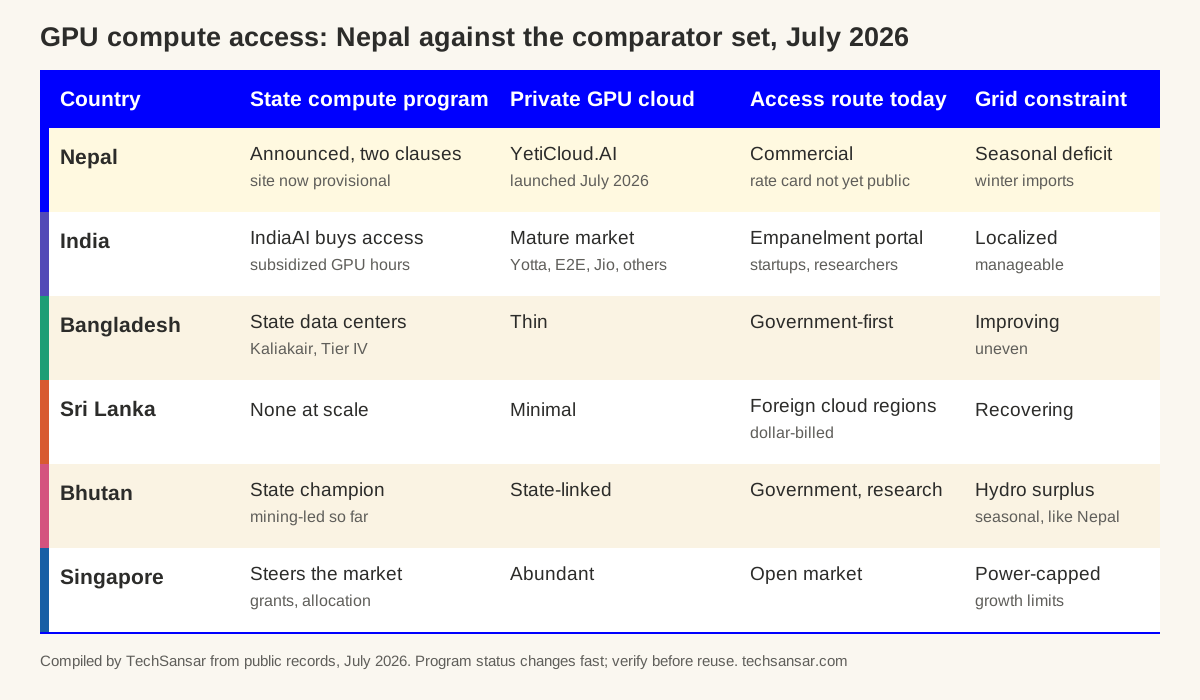
India is the instructive case. Private GPU clouds (Yotta, E2E Networks, Jio, and others) built capacity first, on commercial logic. The IndiaAI Mission then chose not to build a state facility in the first instance; it empaneled private providers and subsidized access to their GPUs for startups and researchers. Public money bought compute hours, not construction risk. Bangladesh ran the opposite order: state-built capacity, including the Tier IV facility at Kaliakair, with a thin private GPU market and a procurement bottleneck between researchers and hardware. Bhutan is the cautionary tale the keynote itself supplied: a state-champion model that monetized cheap power through mining, real revenue, but a dead end halfway up the value ladder. Sri Lanka has neither a sovereign program at scale nor a meaningful domestic GPU market; its developers rent foreign regions in dollars. Singapore sits at the far end: abundant private capacity and a state that steers through grants and allocation while power, not capital, binds growth.
Two lessons transfer. First, no comparator treats a private launch as a reason to cancel public ambition; the successful programs redefined the state’s role around what the market will not supply. Second, the countries that put the most compute into the most hands are the ones where the state spent on access rather than buildings. Dhakal’s enabler language, if it survives contact with procurement reality, points Nepal toward the India pattern. The distance between saying it on a panel and writing it into a project document is where this story now lives.
The case for what launched, taken seriously
The strongest argument for YetiCloud.AI is that it exists, backed by an operator with running facilities in Kathmandu since 2012 and Butwal since 2015, not a paper company assembled for a launch. Local infrastructure delivers things foreign regions cannot: data residency for regulated sectors, latency for inference serving Nepali users (and, in Bredahl’s larger pitch, users across northern India), and support in Nepali time zones and Nepali languages. The panel’s premise, GPU access billed in rupees, attacks the single most exclusionary feature of the status quo: the dollar barrier that keeps students and early startups off foreign clouds entirely, before price even enters the conversation. Billing in rupees is standard practice for Nepali providers and was the panel’s uncontested premise, so the access half of that argument stands: no dollar card required.
The open question is finer: whether GPU prices will be genuinely rupee-denominated or dollar-pegged and merely invoiced in NPR, since the hardware and platform costs underneath are dollar costs. The rate card, when it appears, will answer it. With Bal’s queue-priority argument and the student’s account-friction story, the demand case stopped being hypothetical. The people who would pay made it on stage.
There is also a skills argument. Running GPU infrastructure builds an operations bench that Nepal lacks and that any national facility will need. Every engineer YetiCloud.AI trains is one Syuchatar, wherever it lands, does not have to import.
The case against overreading the launch, taken equally seriously
Now the cold water, and the launch supplied some of it itself. First, scale. DataHub disclosed no GPU model, no count, no capacity, and no rate card. The keynote’s own advice was to start with “five or ten GPUs” and grow. That is a sensible inference business; it is not a training platform, and it is a long way from the tagline “as much as you need.” Until a spec sheet and a rate card exist, “Nepal’s Own AI Infrastructure Platform” is a claim about intent, and “cheaper than any other location in the world” is a claim about nothing measurable at all. We will benchmark both when access opens.
Second, sovereignty by geography is not sovereignty by stack. The hardware sits in Nepal; the platform layer is Hosted.ai’s, the GPUs are Nvidia’s, and the models will mostly be imported open weights. The keynote’s landlord metaphor is effective rhetoric, but by its own logic, a Nepali data center running a foreign platform has swapped a distant landlord for a nearer one with better manners. That is a real improvement in jurisdiction, latency, and support. It is not the full self-determination the branding implies, and the same caveat applies with equal force to the government’s use of the word sovereign.
Third, the grid does not care who owns the GPUs. The winter constraint that hangs over any state facility hangs over YetiCloud.AI identically, and the keynote’s treatment of it was an anecdote (I’ve been here a week, I haven’t seen any power failures yet) plus an honest concession on uptime. No dry-season power strategy was described for the specific facilities hosting the GPUs.
Fourth, one operator is not a market; if YetiCloud.AI remains the only local option, Nepal trades hyperscaler dependence for single-vendor dependence.
And fifth, Manandhar’s serving-cost warning stands: if inference pricing for home-grown models is not aggressive, the platform hosts foreign models for enterprise chatbots and the local-AI promise stays decorative.
The design questions, updated
Before July 3, we would have listed four open design questions for Nepal’s compute policy. The launch answered parts of two and sharpened the rest.
Government as customer, not builder: Dhakal’s enabler framing and the critical/non-critical classification roadmap are the right architecture on paper. The tests are concrete: publication of the classification, the local audit standard actually materializing within his six-to-nine-month window, and the first non-critical government workload landing in a certified private facility. That last step is harder than it sounds, because Nepal’s public procurement framework, built under the Public Procurement Act 2063 around goods, works, and consulting services, has no comfortable category for metered cloud consumption; Dhakal’s own description of hiring “capabilities” from industry for fixed periods reads like an attempt to work around exactly that gap.
Syuchatar’s scope: with the location now officially provisional, the scope question opens wider. If the private sector supplies raw GPU hours, the public facility’s comparative advantage is what markets undersupply: subsidized research access, national dataset hosting, Nepali-language model work, and the data governance layer above the compute. That layer barely exists today: the current framework is a patchwork of the Electronic Transactions Act 2063 and the Privacy Act 2075, and the dedicated data governance act sits in the government’s 100-day program, as the panel moderator noted, still unwritten. A state facility that duplicates YetiCloud.AI would now be competing with a company the government just publicly promised not to compete with.
Access for people without money: the panel surfaced the mechanism itself, compute vouchers for students and researchers. Neither DataHub nor the government committed to one. This remains the test of whether “AI infrastructure for Nepal” includes a masters student in Kirtipur.
Competition and entry: a second local GPU operator matters more than any single facility’s size. The local audit standard Dhakal described is quietly the most important competition policy in this story: Nepal has no dedicated data center regulatory framework today, so whatever certification regime emerges from his ministry’s study will function as the de facto entry rule for the sector, and it should be written with easy entry and neutral interconnection as explicit goals.
What success and failure look like by 2031
Success, five years out: two or more domestic GPU operators competing on published prices; rupee-billed compute as the default for regulated Nepali data; the national facility, at Syuchatar or elsewhere, scoped around research access and national datasets rather than duplicating commercial GPUaaS; at least one Nepali university training models on domestic hardware; government workloads classified and the non-critical tier actually running in certified local facilities; and the executive order on anonymized data signed rather than remembered as a panel remark.
Failure: YetiCloud.AI quietly pivots back to colocation after eighteen months of thin demand; the classification roadmap joins the long shelf of six-to-nine-month roadmaps; the state facility opens as an underutilized showpiece or never opens; and Nepali AI workloads continue running in Mumbai and Singapore regions, billed in dollars. The failure mode is not dramatic. It is two parallel monuments and an unchanged status quo.
What the technology community can do
Treat the launch claims as testable: benchmark the platform when access opens and publish reproducible price-performance comparisons against hyperscaler spot pricing. Take Dhakal’s executive-order offer literally: a consortium of researchers should file a written request for anonymized, non-transactional dataset access this quarter, because an offer made on a panel has a half-life. Ask DataHub publicly for the rate card and an academic tier. And when the compute center’s project documents appear, read them against the market that now exists, not the empty field of May.
And finally,
A private company launched a product, and in doing so extracted more sovereign compute policy from the government in one panel than the budget produced in two clauses. The location is provisional, the posture is enabler-not-competitor, and a classification roadmap with a six-to-nine-month clock is publicly running. Three watchable signals now have dates and owners. The rate card: does YetiCloud.AI publish rupee prices, and do they survive comparison with hyperscaler spot rates? The roadmap: does the data classification and local audit standard appear by roughly April 2027, per Dhakal’s own window? The project document: when the sovereign compute center’s procurement or governance papers appear, do they acknowledge the domestic private capacity that now exists and scope the public facility around what the market does not supply? If the answers are yes, Nepal is running the India play with Nepali characteristics. If not, the country will have built a monument and rented a landlord at the same time. We will review each document, clause by clause, as we did with the budget itself.
Sources and methodology
This analysis draws on the FY 2083/84 budget speech (clauses on the Sovereign AI Compute Center), DataHub’s GPU-as-a-Service page, the YetiCloud.AI site, and Team TechSansar’s attendance at the July 3, 2026 launch at Hotel Marriott, Kathmandu, on DataHub’s invitation, with no payment or editorial condition. Keynote quotations are from Ditlev Bredahl’s presentation, lightly edited for filler; panel quotations, including those of Joint Secretary Subash Dhakal, Prof. Dr. Bal Krishna Bal, and Dr. Suresh Manandhar, are translated from Nepali where applicable and edited for clarity, from our transcript of the session. Speakers were not offered quote review. The curtailment figure cited in the keynote is checked in the text against Kathmandu Post reporting on NEA output-reduction directives and IPPAN’s FY 2081/82 curtailment estimate; the definitional caveat on what counts as curtailed energy is ours. DataHub disclosed no hardware specification, capacity, or pricing at the launch. Comparator claims rest on public program documents, including the IndiaAI Mission compute empanelment, and the scorecard reflects our best reading of the public record as of July 2026. Analytical judgments, including the 2031 scenarios, are Team TechSansar’s own.