


On Jestha 15, 2083 (May 29, 2026), Finance Minister Dr. Swarnim Wagle tabled the FY 2083/84 federal budget in a joint session of parliament of Nepal. Total outlay is NPR 2,124.34 billion, divided into recurrent (59.8 percent), capital (20.3 percent), and financial management (19.9 percent) components, financed against a real GDP growth target of 7 percent and an inflation ceiling of 6 percent.
For the technology, telecommunications, startup, and digital governance sectors, the speech is unusually consequential. It commits to a 50 percent income tax exemption on IT services exports, the country’s first Sovereign AI Compute Center at Syuchatar in Kathmandu, a partial divestment of Nepal Telecom, a legal framework for remote work, and a long list of tax and procedural reforms relevant to anyone who builds, ships, or operates technology products and services from Nepal.
This piece is a reference: clause-by-clause, sourced where possible to the primary text of the budget speech published by the Ministry of Finance and to the annexes accompanying it. It is the first in a TechSansar series on the budget’s technology provisions. Part 2 will examine the Sovereign AI Compute Center in depth.
The shape of the budget in numbers
The macro composition of the FY 2083/84 outlay is summarised below. All figures are in NPR billion (arba) unless otherwise stated, drawn from Annex 1 of the budget speech.
| Head | FY 2081/82 actual | FY 2082/83 revised | FY 2083/84 estimate |
|---|---|---|---|
| Recurrent expenditure | 607.23 | 712.23 | 1,270.58 |
| Capital expenditure | 223.98 | 251.40 | 431.10 |
| Financial management | 349.37 | 402.81 | 422.64 |
| Total expenditure | 1,180.57 | 1,366.43 | 2,124.34 |
| Tax revenue | 1,049.88 | 1,171.59 | 1,403.32 |
| Non-tax revenue | 128.94 | 122.49 | 177.00 |
| Foreign grants | 27.18 | 31.00 | 61.74 |
| Foreign loans | 127.20 | 141.96 | 247.28 |
| Net domestic borrowing | 9.36 | (117.04) | (164.11) |
The headline expenditure rises 25.2 percent over the FY 2082/83 revised estimate. Capital expenditure rises 71.5 percent — a number that should be read with caution given Nepal’s consistent under-execution of capital budgets in recent years, a pattern documented in successive IMF Article IV consultations and World Bank Nepal Development Updates.
Fiscal transfers to provinces and local governments cross NPR 600 billion through equalisation, conditional, special, and complementary grants combined with revenue sharing.
Tech-relevant allocations at a glance
The budget does not contain a consolidated “technology” sector envelope. Tech-relevant spending is distributed across the Ministry of Communications and Information Technology, the Ministry of Science, Technology and Innovation (newly constituted), the Ministry of Energy and Water Resources, and various financial management line items. The principal allocations are:
| Sector / Item | FY 2083/84 allocation (NPR) | Reference |
|---|---|---|
| Information and Communication | 5.93 billion | Clause 45 |
| Science, Technology and Innovation | 4.00 billion | Clause 57 |
| Nepal Enterprise Facility (startup platform) | 50 crore | Clause 57 |
| Public welfare advertising (print + electronic) | 33 crore | Clause 45 |
| Energy sector (production, transmission, distribution) | 85.54 billion | Clause 43 |
| Minimum R&D and innovation set-aside (1% of capex) | ~4.30 billion | Clause 28 |
The NPR 5.93 billion Information and Communication allocation is broadly consistent with prior years and is to be deployed across the Telecommunications Authority Bill, telecom infrastructure expansion in Karnali and Sudurpashchim, the integrated secure government printing entity, and the social media business activity promotion line.
The NPR 4 billion science, technology and innovation envelope is the headline outlay for the new Ministry of Science, Technology and Innovation and includes the controversial astronomical observatory at Sagarmatha base camp, fellowship programmes for AI researchers, and other innovation-promotion line items.
The Sovereign AI Compute Center itself is not explicitly costed in the published clause text and is expected to be capitalised in part through the Mathrubhumi Fund described in Clause 15.
TechSansar’s prior coverage of Nepal’s ICT budget allocations over the past five years →
The IT services tax bonanza (Clause 68)
The single highest-impact clause for Nepal’s commercial IT industry is Clause 68, which delivers two structural concessions.
A 50 percent income tax exemption on income earned from exporting IT services. Read literally, this halves the effective income tax burden — for both individuals and corporate entities — on revenue booked against foreign clients for software development, SaaS subscription, IT-enabled services, and analogous categories. The exemption applies to the export portion of revenue, so businesses serving both domestic and foreign clients will need to track and apportion income.
A 100 percent income tax exemption on sweat equity received by IT workforce. This is the more technically interesting concession. Sweat equity (stock or equity instruments received by employees in lieu of cash compensation) has historically been treated as ordinary income at the time of vesting under Nepal’s Inland Revenue Department guidance. Treating it as fully exempt at vesting brings Nepal closer to the treatment available in established startup jurisdictions, where the tax event typically arrives at sale, not at vest.
Two operational questions will determine how much of the headline benefit reaches practitioners.
First, the IRD’s definition of “IT services” for exemption purposes. The narrower the scope (pure software development only), the smaller the affected pool. The broader the scope (any digitally delivered service to a foreign client, including business process outsourcing, content moderation, data labelling, and remote operations), the more transformative the policy. Comparable jurisdictions such as the Philippines and Vietnam have settled this through detailed schedules to the income tax law; Nepal will likely follow a similar approach in the Finance Bill or subsequent IRD circular.
Second, the residency and source rules. An IT exporter incorporated in Nepal but invoicing through a foreign subsidiary may not qualify. An individual freelancer receiving payment through a personal foreign account may face documentation challenges. The architecture that makes the exemption usable at scale is the same architecture that prevents it from being abused and that architecture is operational, not in the speech.
The 100 percent sweat equity exemption is paired with the 50 percent export concession in a way that suggests the drafters intended a coordinated policy package for IT exporters. If implemented thoughtfully, this is the most pro-IT-industry fiscal package any Nepali budget has produced.
https://techsansar.com/nepali-it/nagarik-app-national-id-egovernance-nepal/
The Sovereign AI Compute Center (Clause 18)
The country’s first Sovereign AI Compute Center is to be established at Syuchatar, Kathmandu. The Ministry of Finance commits to procuring “thousands” of AI Processing Units (GPUs) and offering subsidised compute capacity to Nepali AI startups and entrepreneurs. The underlying thesis is the conversion of Nepal’s hydropower surplus into AI compute services both for domestic consumption and as a tradable digital export.
Alongside the infrastructure commitment, Clause 18 announces:
- Prestigious fellowships for at least 15 internationally recognised Nepali AI researchers to return and contribute.
- Prioritisation of mathematics and other foundational sciences in higher education as the AI talent pipeline.
The Mathrubhumi Fund described in Clause 15 – a strategic investment vehicle funded from a portion of Nepal’s foreign exchange reserves explicitly names “AI Factory” as one of its target investment classes alongside three-month strategic fuel storage.
Comparable sovereign AI initiatives elsewhere be it IndiaAI Mission, Saudi Arabia’s HUMAIN under the Public Investment Fund, and the UAE’s G42 offer reference architectures for governance, GPU procurement, allocation policy, and ecosystem development. The execution risk for Nepal lies primarily in three areas: GPU supply chain constraints under prevailing US export controls, governance design for the center itself, and the design of subsidised access for startups.
A detailed analysis of Clause 18, the hydropower-to-AI economics, GPU procurement governance, and the fellowship architecture appears in Part 2 of this series.
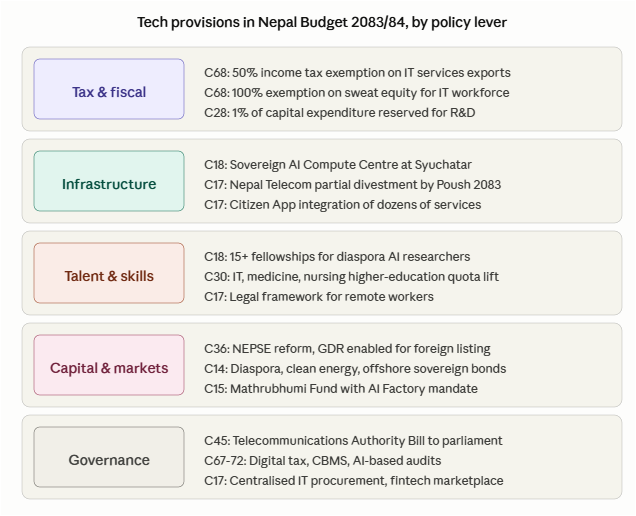
Nepal Telecom partial divestment (Clause 17)
The federal government will retain 66 percent of Nepal Telecom and sell the remaining shares to the public by the end of Poush 2083 (mid-January 2027). Proceeds are committed to making Nepal a “TechHub.”
This is the first concrete partial-privatisation commitment from the current government and arrives in a context where Nepal Telecom remains a cash-generative incumbent with substantial passive infrastructure (fibre, towers, real estate, spectrum) and a market share that, while declining, still positions it as systemically significant. Public float at a competently structured offer price would deepen the Nepal Stock Exchange, increase the free-float weighting of listed telecoms, and establish a precedent for the partial divestment of other state-owned commercial enterprises listed in Clause 16 including Rastriya Banijya Bank capital increase, Nepal Airlines Corporation corporatisation, Nepal Life Insurance Company share issuance, Bishal Bazaar Company share issuance, and the proposed restructuring of seven other public enterprises under a DDA (due diligence and asset valuation) framework with public-private partnership investment management.
The “TechHub” framing is loose. Three operational tests will determine whether the divestment proceeds are deployed credibly:
- Are proceeds ringfenced or do they flow into general consolidated fund?
- Is there a published deployment plan with measurable outcomes — gigabit broadband coverage targets, public cloud capacity, IXP and submarine cable redundancy, or AI compute co-financing?
- Is the share float priced for retail participation or for institutional capture?
The answer to these will determine whether the Nepal Telecom partial divestment is recorded as Nepal’s first serious sovereign technology asset monetisation or as a familiar fiscal patch.
Remote work, legalised (Clause 17)
A single sentence in Clause 17 commits the government to clear legal arrangements for remote workers serving foreign employers from Nepal and to attracting remote work. The clause is short on operational detail and long on potential implications.
Nepal already hosts an undocumented but substantial population of remote workers (like engineers, designers, product managers, operations and support staff) employed by foreign companies. The current regime has functioned through workarounds: personal foreign accounts, freelancer platforms, irregular tax filings, and forex controls that pretend the global remote economy does not exist. A formal legal framework would address:
- Tax residency definitions for individuals on foreign payrolls based in Nepal.
- Permissible inbound payment channels for service income (distinct from wage remittance from foreign labour).
- Social security contribution treatment for remote workers.
- Potentially a digital nomad visa for inbound remote talent.
- Treatment of stock and equity compensation received from foreign employers (interacting with Clause 68’s sweat equity exemption).
International comparators include Portugal’s digital nomad visa, Estonia’s e-Residency programme, and Indonesia’s recent remote work permits. Each has different design choices on tax residency, social security, and payment channels. Nepal’s drafting committee composition for the implementing regulations will determine which model the framework approaches.
Pairing this clause with Clause 17’s separate provision permitting Nepali nationals to invest abroad (explicitly mentioned in the context of IT services sector expansion) produces a coherent outbound integration agenda. Nepali IT firms gain a legal route to set up foreign-incorporated subsidiaries for client billing; Nepali individuals gain a legal route to be employed by those subsidiaries or others.
Outbound investment and centralised government IT procurement (Clause 17)
Two further provisions in Clause 17 deserve attention.
The first opens a clearer path for Nepali firms to make outbound investments, with explicit reference to IT services expansion abroad. Historically, Nepali companies seeking to establish Delaware C-Corps, Singapore Pte Ltds, or other foreign vehicles for client invoicing have navigated an opaque, partially extra-legal route. Formalising this aligns Nepal with the regulatory baseline available in India, Pakistan, and Bangladesh.
The second consolidates the procurement of IT software used by government bodies into a single centralised entity. The stated objective is to reduce duplication and enforce interoperability. The international evidence on centralised IT procurement is mixed: it can deliver volume pricing and interoperability dividends, but creates a concentrated procurement surface that requires above-average governance to avoid capture. The decisive variables are whether the centralised procurement entity publishes its evaluation criteria, its awarded contracts, and its integration standards openly and whether there is an explicit preference framework for Nepali software vendors meeting functionality and security baselines.
Digital public infrastructure and the Citizen App (Clause 17)
Clause 17 commits to increased investment in digital public infrastructure and to integrating “dozens of government services” into the Citizen App. A fintech marketplace will be established under the supervision of Nepal Rastra Bank.
The DPI commitment is directionally sound but architecturally underspecified. Nepal possesses the foundational building blocks — National ID rollout, NEPALPAY and ConnectIPS as real-time payment rails, the Citizen App as a citizen-facing portal — but lacks the integration layer that converts these from a collection of services into a platform. The question whether the Citizen App becomes a thin front-end calling out to ministry systems or a serious DPI platform with shared identity, payment, notification, and data exchange layers is not answered in the budget. It will be answered in the technical implementation decisions of the next twelve months.
The fintech marketplace under NRB supervision is a meaningful regulatory commitment. It implies a structured sandbox or licensing framework analogous to those operated by the Monetary Authority of Singapore, the Reserve Bank of India, or the UK’s Financial Conduct Authority. The architecture of that framework will determine whether Nepali fintech startups can iterate domestically or continue to incorporate abroad for regulatory clarity.
The Dollar Dilemma: How Nepali Developers Pay for Global Cloud Services (CloudNepal.net)
Startups and innovation (Clause 28)
Clause 28 functions as a compact startup policy. The provisions:
- Profit-linked tax concessions for startups.
- Priority access in public procurement for startups.
- Digital registration and regulatory facilitation through the Investment Express concept (Clause 26).
- A funding model explicitly moving beyond debt-only: early stage grants, soft loans for proven concepts, growth capital for scaling firms.
- Encouragement of co-investment with private sector and non-resident Nepalis.
- A minimum 1 percent of capital expenditure reserved for science, technology research, and innovation.
The 1 percent commitment is the most quantitatively significant. With capital expenditure budgeted at NPR 431 billion, the floor allocation for science, technology, and innovation is approximately NPR 4.3 billion. Combined with the explicit NPR 4 billion science envelope and the NPR 50 crore Nepal Enterprise Facility allocation in Clause 57, the aggregate innovation envelope is meaningful by Nepali budget standards though small relative to peers such as Startup India or Bangladesh’s iDEA programme.
The Nepal Enterprise Facility itself is described as a platform aggregating policy, financial instruments, incubation, and ecosystem support for startups and SMEs. A single integrated platform is architecturally superior to the fragmented scheme-by-scheme approach Nepal has historically used. Its operational design — governance, allocation criteria, public reporting — has not yet been published.
Clause 26 introduces an “Investment Express” concept for automated routing of investor applications through company and industry registration, financial services, tax compliance, and visa processing. This consolidates several existing systems into a single user journey. Clause 10 commits to amendments to the Companies Act, the Limited Liability Partnership Act, the Foreign Investment and Technology Transfer Act, and the Industrial Enterprise Act to support this architecture.
Digital tax administration (Clauses 67–73)
The revenue chapter of the budget is the section that will most directly affect the day-to-day operation of businesses in Nepal. Key provisions:
- Mandatory enrolment in the Central Billing Monitoring System (CBMS) for all businesses with annual turnover above NPR 10 crore that issue electronic invoices.
- AI-based e-assessment for risk-based tax audits — a deployment of machine learning to identify high-risk returns for examination, paralleling similar deployments by the Indian Income Tax Department and other revenue administrations.
- Digital excise tickets and an electronic track-and-trace system to control excise leakage.
- A move toward paperless, faceless, and contactless revenue administration (should we say the same architectural posture pursued by India’s Faceless Assessment Scheme.)
- A 10 percent VAT discount on consumer purchases made through digital payment at the point of sale, implemented at invoice issuance.
- A lottery programme for billed transactions, designed to incentivise consumers to demand invoices.
- A three-year window for tax assessment, codifying the period during which the IRD may examine a return.
- An authorised business person designation for trade facilitation, with blue-lane customs clearance.
- A digital customs clearance system extension with transaction-value-based assessment.
Clause 70 abolishes the Revenue Investigation Department as a standalone entity, with its functions absorbed into subject-matter agencies. Clause 70 also commits to a performance-indicator-based incentive scheme for revenue administration staff.
These provisions together constitute the digital tax modernisation agenda Nepal has lacked. Their effective implementation depends on Inland Revenue Department capacity, Department of Customs technical capacity, and the integration architecture connecting them to the National Payment Switch and the National ID system.
Telecommunications Authority Bill (Clause 45)
Clause 45 commits to tabling a Telecommunications Authority Bill in parliament. Specific provisions include accelerated deployment of newest-generation telecom technology, expanded quality telephony in Karnali and Sudurpashchim provinces, and the consolidation of government printing infrastructure into a single secured printing entity. NPR 33 crore is allocated for public-welfare advertising in print and electronic media.
The Telecommunications Authority Bill is the structural piece. Nepal’s existing regulator, the Nepal Telecommunications Authority, operates under a 1997 act that predates 3G deployment, smartphone proliferation, OTT services, and meaningful internet penetration. A new authority bill that updates the regulatory perimeter to include OTT services, data protection adjacencies, spectrum allocation modernisation, and cloud and edge service licensing could unlock a generation of investment. A poorly drafted bill could lock the sector into further regulatory drag. The drafting committee composition and the consultation process will determine which.
International reference points include the ITU’s Regulatory Outlook reports and the Telecom Regulatory Authority of India’s recent OTT consultations.
Skills, education, and the AI talent pipeline (Clauses 18, 30, 47, 50)
The talent pipeline provisions are distributed across several clauses.
Clause 30 commits to reviewing higher education quotas in disciplines including medicine, nursing, and information technology in the current fiscal year, with significant increases promised. For Nepal’s technology sector, where the principal bottleneck is engineering seat capacity at universities rather than demand, quota expansion is the cleanest available structural lever.
Clauses 30 and 50 commit to a National Qualifications Framework and Recognition of Prior Learning, providing formal recognition for skills acquired by migrant workers, informal sector workers, and experienced practitioners. Paid internships are to be institutionalised. Foreign universities are to be permitted to open campuses in Nepal under new policy.
Clause 18’s commitment to prioritise mathematics and foundational sciences in higher education is the longest-horizon talent pipeline commitment in the budget. The pay-off, if sustained, accrues over 8 to 12 years — the time required for current secondary students to complete higher education and enter the workforce.
The Clause 18 fellowship programme — at least 15 internationally recognised Nepali AI researchers — provides a near-term talent reversal lever. The architecture of these fellowships (compensation, research budgets, term length, institutional placement, integration with the Sovereign AI Compute Center) will determine whether they attract genuinely senior talent or function as symbolic appointments.
Sagarmatha observatory and the R&D commitment (Clause 57)
Clause 57 allocates NPR 4 billion for science, technology, and innovation activities. Two specific commitments deserve note.
The first is the establishment of an astronomical observatory at Sagarmatha base camp for the promotion of astro-tourism. The high altitude, low light pollution, and clear atmospheric conditions of the upper Khumbu region offer credible observational advantages. The economic case rests on the small but growing global market for astro-tourism. Operational success will depend on the center’s design (research instrumentation versus visitor facilities), connectivity, and integration with existing tourism flows.
The second is the Nepal Enterprise Facility already discussed above capitalised initially at NPR 50 crore. Clause 28’s commitment that 1 percent of capital expenditure (approximately NPR 4.3 billion at the budgeted level) be set aside for R&D and innovation is the broader envelope into which these specific allocations fit.
The aggregate science-technology-innovation envelope combining Clause 57’s NPR 4 billion, the 1 percent capex set-aside, and earmarked allocations within other ministries — is, by Nepali budget standards, substantial. It is also, by international peer standards, modest. The signal is directional; the scale is preliminary.
What is conspicuously missing
A reference piece on the technology provisions of this budget must note what is not in it.
Data protection legislation. The Privacy Act 2075 is the operative privacy law and predates the data-intensive AI economy this budget envisions. There is no commitment in the budget to a modern data protection law, no mention of a data protection authority, and no signal on cross-border data flow regulation. The omission is consequential: a sovereign AI compute strategy without a sovereign data protection regime is architecturally incomplete.
National cybersecurity strategy. The National Security Policy 2075 is up for review (Clause 62). Cybersecurity receives one indirect mention in the context of police technology. For a country digitising tax administration, citizen services, payments, capital markets, and critical infrastructure, a national cybersecurity strategy with budget, designated lead agency, and operational reporting line is the international baseline. Nepal’s first major incident — and there will be one — will expose this omission.
Cloud and data center policy. The Sovereign AI Compute Center is announced, but the regulatory framework for the broader cloud and data center industry — tier certification, data residency requirements for regulated sectors, treatment of international hyperscaler presence, incentive scheme for qualifying facilities — is not addressed. International reference points include Singapore’s IMDA framework, India’s evolving Data Center Policy, and Pakistan’s draft data center policy. Nepal currently has none.
AI governance and safety framework. The budget treats AI exclusively as an industrial opportunity. There is no AI ethics framework, no algorithmic accountability requirement, no commitment to a sectoral AI risk classification (analogous to the EU AI Act or the US NIST AI Risk Management Framework). As government itself becomes a major AI deployer, this gap matters.
FATF grey list exit architecture. Clause 15 commits Nepal to exit the FATF grey list “as soon as possible.” The specific legislative, procedural, and compliance commitments required for this exit are not detailed.
These omissions are not, individually, fatal. They constitute the next phase of policy work what should appear in the implementing regulations, in mid-cycle legislation, and in the next budget. The technology community’s role in the next twelve months is to maintain public pressure for these gaps to be filled.
What to watch over the next twelve months
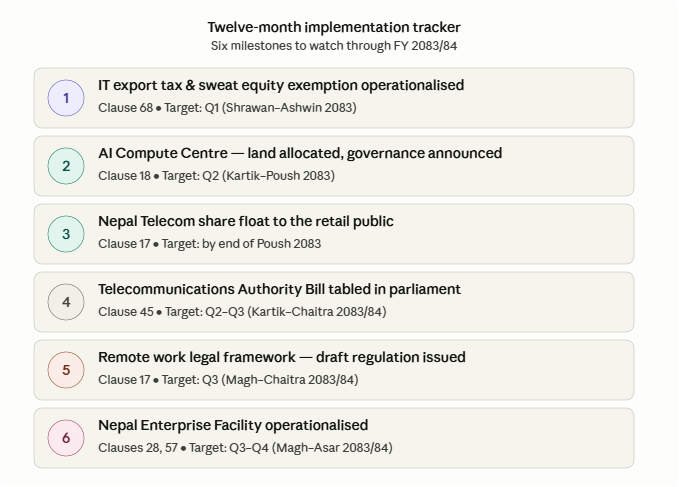
Six implementation milestones over the next four quarters will determine whether this budget is remembered as a turning point or as a list of beautiful clauses. They are summarised in the implementation tracker accompanying this article.
- Finance Bill amendment delivering the 50% IT export exemption and 100% sweat equity exemption with clear IRD operational guidance. Target: Q1 FY 2083/84 (Shrawan–Ashwin / July–September 2026).
- Syuchatar AI Compute Center land allocation and governance announcement – designated owner-operator with published charter. Target: Q2 FY 2083/84 (Kartik–Poush / October–December 2026).
- Nepal Telecom share float by end of Poush 2083 with transparent allocation between retail and institutional buyers. Target: Q2 FY 2083/84.
- Telecommunications Authority Bill tabled in parliament with a modern regulatory architecture. Target: Q2–Q3 FY 2083/84.
- Remote work legal framework draft regulation addressing tax residency, payment channels, and social security. Target: Q3 FY 2083/84 (Magh–Chaitra / January–March 2027).
- Nepal Enterprise Facility operationalisation with NPR 50 crore deployed through a single transparent platform. Target: Q3–Q4 FY 2083/84.
If three of these six deliver, the budget is a real reform package. If five do, it is historic. If only one or two land, the document joins the long list of speeches that became press cycles and nothing else.
Sources and methodology
This article is based on the official budget speech text published by the Nepal Ministry of Finance on Jestha 15, 2083 (May 29, 2026), including the budget speech document, its 15 annexes covering revenue projection, sectoral allocations, ministry-wise expenditure, fiscal transfers, gender-responsive and climate-relevant budget breakdowns, and the foreign aid summary. All clause references are to the numbered paragraphs in the published speech. All figures in NPR are sourced from the speech annexes unless otherwise indicated.
Comparative international references are sourced to the relevant primary institutions cited inline. Analytical statements describe the reasonable implications of the budget text and are clearly distinguishable from the text itself.
The article does not summarise the budget; it provides reference-grade detail on the technology-relevant provisions for use by practitioners, researchers, and other writers seeking to cite specific clauses. Readers seeking a comprehensive sectoral overview should consult the primary speech text published at mof.gov.np. You can find the actual budget 2083/84 speech here in Nepali and unofficial English translation here from qrsansar.com.
This article is Part 1 of a TechSansar series on Nepal Budget 2083/84. Part 2 examines the Sovereign AI Compute Center at Syuchatar in depth. Future coverage will track the implementation tracker milestones quarterly.





Comments 1