This article is Part 2B of a TechSansar series on the FY 2083/84 Nepalese federal budget. Part 2A set out the technical explainer for the Sovereign AI Compute Center at Syuchatar. This piece places that announcement in regional context and asks whether the policy choice is the right one.
A note on sources. Part 2A established that no publicly available technical specification, governance charter, or procurement document exists for the Syuchatar center at the time of writing, and that no private intel was available to this author. The comparative material in this article (on IndiaAI, Bhashini, Sri Lanka’s GPU procurement, Bangladesh’s AI policy, and other regional programs) is drawn from publicly available primary sources, cited inline. Where any comparator country’s information is also incomplete or moving fast, this article says so. This commentary is only as good as the publicly available information – EL.
The question the announcement asks
The decision to build a sovereign AI compute center is not a technical decision. It is a strategic one. It commits a country to a particular theory of how artificial intelligence will shape its economy and its national security, and it commits substantial public capital and political attention to that theory rather than to alternative uses of the same resources.
For a country at Nepal’s stage of digital development (per capita GDP of approximately USD 1,400 by World Bank 2024 estimates, broadband penetration still uneven across the federal structure, a small but growing IT export sector, a research base concentrated in a handful of universities), the relevant question is not whether sovereign AI compute matters in principle, but whether it matters more than the policy alternatives at the margin.
This article does not answer that question definitively. The honest answer requires information that is not yet public. But it lays out the framework within which the question should be answered, places Syuchatar in the regional pattern, and identifies the three or four design choices that determine whether the eventual facility becomes infrastructure or becomes a press cycle.
What the region has actually done
Regional Sovereign AI Compute Scorecard (mid-2026)
Sources and methodology for this scorecard: • India: IndiaAI Mission portal (indiaai.gov.in), parliamentary disclosures 2024-2025 • Sri Lanka: Information and Communication Technology Agency (icta.lk) public materials • Bangladesh: Ministry of Posts, Telecommunications and Information Technology (ict.gov.bd) • Bhutan: General public infrastructure record, no central sovereign AI compute announcement at time of writing • Nepal: FY 2083/84 federal budget speech, Ministry of Finance (mof.gov.np), Clauses 56 and 57 • Nepal row is intentionally sparse. As of mid-2026, no publicly available technical specification, governance charter, procurement document or budget allocation for Syuchatar exists. This scorecard is only as good as the public record at time of writing.
| wdt_ID | wdt_created_by | wdt_created_at | wdt_last_edited_by | wdt_last_edited_at | Country | Program | Investment | Scale | Operator model | Access model | Status |
|---|---|---|---|---|---|---|---|---|---|---|---|
| 1 | Ek | 30/05/2026 03:21 PM | Ek | 30/05/2026 03:21 PM | India | IndiaAI Mission | USD 1.24 billion over 5 years | 18,693 GPUs procured by 2025 | Independent business division under MeitY | Hybrid subsidy: startups, academia, government | Operating |
| 2 | Ek | 30/05/2026 03:21 PM | Ek | 30/05/2026 03:21 PM | Sri Lanka | ICTA-led program | Modest, undisclosed | Research-grade cluster | ICTA with university partners | Academic NLP focus on Sinhala and Tamil | Building |
| 3 | Ek | 30/05/2026 03:21 PM | Ek | 30/05/2026 03:21 PM | Bangladesh | Policy-first framework | No major outlay announced | None announced | MoPTIT policy-led | Policy framework stage | Pre-build |
| 4 | Ek | 30/05/2026 03:21 PM | Ek | 30/05/2026 03:21 PM | Bhutan | Cloud-first by choice | N/A, deliberate choice | Commercial cloud reliance | Various, by use case | Commercial cloud with selective on-prem | Operating |
| 5 | Ek | 30/05/2026 03:21 PM | Ek | 30/05/2026 03:21 PM | Nepal | Syuchatar Sovereign AI Compute Center | Not disclosed | Not disclosed | Not disclosed | Not disclosed | Announced |
Five regional programs are useful comparators for Syuchatar. Each is sized differently, designed differently, and has produced different outputs to date. The summary below is current as of mid-2026 and draws from primary government sources cited inline.
India — the IndiaAI Mission
The Government of India approved the IndiaAI Mission in March 2024 with a financial outlay of INR 10,372 crore (approximately USD 1.24 billion) over five years. The mission is administered by the IndiaAI Independent Business Division within the Ministry of Electronics and Information Technology. According to the IndiaAI portal and disclosures in Parliament during 2025, the IndiaAI Compute pillar had procured 18,693 GPUs as of its 2025 publications, distributed across approved empanelled service providers under a subsidy mechanism. The access model is a hybrid: empanelled providers serve startups, academia, and government use cases at subsidized tariffs, with central subsidy buying down the per-GPU-hour price below commercial market rates.
The IndiaAI Mission also funds five additional pillars: a Foundation Models program, an Innovation Center, a Datasets Platform, an Applications Initiative, and a Future Skills program. The structure is significant because the compute pillar is one of six co-funded workstreams, not a standalone facility. The data, model, and applications layers are funded simultaneously.
India — Bhashini
The Bhashini program is the language-stack layer that sits above (and partly parallel to) IndiaAI compute. It is operated by the Digital India Bhashini Division and aims to provide translation, speech-to-text, text-to-speech, and language model APIs across India’s 22 scheduled languages. According to the Bhashini portal and the published Bhashini API documentation, the program has integrated open-source models, fine-tuned them on Indian-language corpora collected from public broadcasters and government text, and exposed them through a unified API.
Bhashini is the structural piece worth attention. It demonstrates that sovereign compute is most valuable when paired with a sovereign language and data program. Compute alone, without the corpora and the model layer above it, does not produce visible national-language AI outputs.
Sri Lanka
Sri Lanka’s Information and Communication Technology Agency has moved more incrementally. Publicly reported steps include a national AI strategy published in draft form, an early commitment to procure modest GPU capacity for academic and research use through partnerships with universities, and an emphasis on Sinhala and Tamil language NLP. The Sri Lankan approach is, in effect, a small research-grade cluster rather than a national sovereign compute facility, which is a defensible design for a country of similar economic scale to Nepal.
Bangladesh
The Government of Bangladesh’s Ministry of Posts, Telecommunications and Information Technology has signaled AI policy intent through draft policy documents and selective infrastructure investment. Bangladesh has emphasized AI within the broader Digital Bangladesh and Smart Bangladesh framing rather than as a standalone sovereign compute program. As of mid-2026, Bangladesh does not have a publicly announced GPU procurement at the scale of IndiaAI.
Bhutan
Bhutan is interesting as a small-country comparator. Its approach has been pragmatic: cloud-first for most workloads via commercial providers, with selective on-premises infrastructure for specific sovereignty-sensitive use cases. Bhutan has not announced a sovereign AI compute center. This is not an oversight; it is a deliberate strategic choice given the country’s scale and the maturity of commercial cloud options accessible to it.
Singapore — relevant as a model, not as a comparator
Singapore is not directly comparable in scale to Nepal, but it is worth noting because its Infocomm Media Development Authority has run one of the most thoughtfully designed sovereign AI programs, including the Foundation Model investment under the National Multimodal LLM Programme. Singapore’s choices (a specific multimodal model focus, a multi-language corpus including Southeast Asian languages, a clear access model for researchers) are the kind of design choices that distinguish sovereign compute that delivers from sovereign compute that doesn’t.

Where Nepal sits in this pattern
Three things are striking about the announcement of Syuchatar against this regional picture.
First, Nepal is leapfrogging the policy sequencing that most regional comparators followed. India announced IndiaAI after multiple rounds of consultative AI policy work, after the existence of Bhashini, and after a published national AI strategy. Sri Lanka moved from policy to small infrastructure. Bangladesh has prioritized policy. Nepal has announced infrastructure without a publicly visible national AI strategy preceding it. This is not necessarily wrong, but it does mean the strategic frame for the center will need to be articulated after the announcement rather than before. Nepal published a National AI Policy in 2082; this article does not assess it because the document’s relationship to the Syuchatar announcement is not yet specified.
Second, Nepal is not announcing a corresponding data and model program. There is no Nepali-language equivalent of Bhashini in the FY 2083/84 budget, no announcement of a national Nepali-language corpus collection effort, no fellowship or research program to seed model development. If Syuchatar is built and the layers above it are not built, the most likely outcome (based on the regional pattern) is under-utilization. A Nepali AI fellowship program, modeled on the IndiaAI Fellowships, would be the most efficient parallel investment to seed the workforce that any sovereign compute facility will require.
Third, Nepal is announcing sovereign compute at a scale that has not been specified. India committed USD 1.24 billion. Sri Lanka has committed modest research-grade capacity. Bhutan has committed nothing because it has assessed that commercial cloud is sufficient for its needs. Where Syuchatar will sit on this scale will determine its meaning, and the speech does not say.
One detail worth noting about the site choice. Syuchatar already houses NEA’s Load Dispatch Center, the operational core of the national grid, and significant transmission infrastructure. This is presumably not a coincidence. A high-density GPU facility needs reliable medium-voltage power, redundant feeders, and ideally a substation within metres rather than kilometres. Co-locating with existing NEA infrastructure addresses the largest physical-realities risk for a Kathmandu Valley data center. The budget speech does not say this is the rationale, and NEA has not published a capacity allocation, but the geography is suggestive.
The case for sovereign compute, taken seriously
The strongest version of the case for Nepal building sovereign AI compute, on its merits, runs as follows.
Nepal’s national-language data, particularly Nepali and the other languages of the country, will not be adequately represented in commercial frontier models trained primarily on English-language web data. If Nepal wants AI tools that work well in Nepali (for government service delivery, for health, for education, for citizen interaction with the state), it will need to fine-tune or pre-train models on Nepali corpora. Doing that at scale requires compute, and the data sovereignty considerations around citizen language data argue for that compute being in Nepal rather than in a hyperscaler’s data center in another jurisdiction.
There is also a development case. A subsidized national compute resource lowers the barrier to entry for Nepali researchers, startups, and applied teams to work on AI. The spillover effects from such a program can be substantial if the access model is designed well.
And there is an industrial policy case. Nepal’s IT export sector, particularly the services component, is a growing share of foreign exchange earnings. AI-augmented services exports are likely to grow as a share of the global market. A sovereign compute capability, used by Nepali firms, can be part of how Nepal participates in that market on something other than wage-arbitrage terms.
These are real arguments. They are not the whole story, but they are the strongest version of the case, and Syuchatar should be evaluated against whether it is being designed to deliver on them.
The case against, also taken seriously
The strongest version of the case against runs as follows.
Frontier AI compute is a fast-moving target. The GPU generation a country procures in 2026 will be substantially less competitive in 2028. The depreciation curve on AI training hardware is steep, and the operating cost (power, cooling, replacement parts, skilled operations team) is high. A country that builds sovereign compute is committing to a recurring expense, not a one-time investment.
Commercial cloud options for sovereign-style workloads have matured substantially. AWS, Azure, Google Cloud, and Oracle now offer in-country or near-country regions in or close to South Asia, with confidential computing options that meaningfully address data residency concerns. The marginal cost of using commercial cloud for sovereign-sensitive workloads has dropped, and the marginal capability has risen.
The operational reality of running a high-utilization GPU cluster requires a skill base that takes years to build. Countries that have built clusters without that skill base in place have reported under-utilization, hardware failures, and operating costs substantially above plan.
The opportunity cost is real. The capital and political attention spent on sovereign compute is capital and political attention not spent on broadband expansion, on data protection law, on a national cybersecurity strategy, on cloud policy, on AI safety governance, on the education and research base, or on the data layer that would make the compute usable.
None of these arguments is a refutation. Each is a constraint that the design of Syuchatar needs to address.
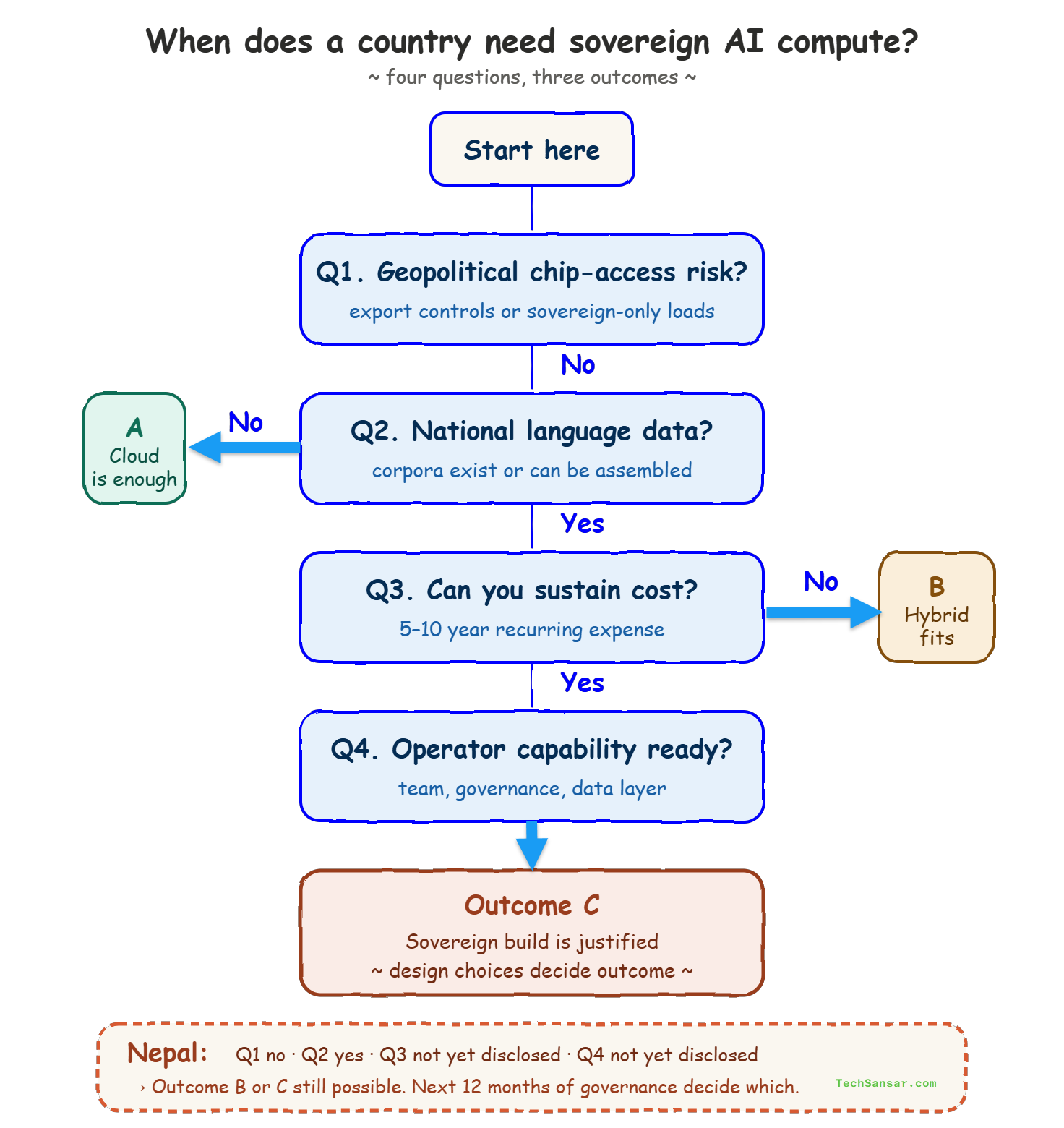
Four governance questions that determine the outcome
From the regional pattern and from the structural realities described above, four governance questions stand out as the ones that will determine whether the Syuchatar center becomes useful infrastructure or becomes a press cycle.
1. Is the operator a politically independent body? The comparator programs that have delivered (IndiaAI under its independent business division, Singapore’s IMDA-administered programs) have been run by entities with sufficient operational independence to make procurement, hiring, and access decisions on technical merit rather than political pressure. Nepal’s record of operating state-owned enterprises and authorities of this kind is mixed. The governance announcement, when it comes, will signal a great deal.
2. Is there a clear, published access model? Compute without a published access policy ends up allocated by informal channels. The published access policy (free academic tier, paid commercial tier, sovereign reserve, oversight committee) is what determines whether the broader Nepali AI ecosystem actually gets to use the facility.
3. Is the data and model layer being built alongside? Compute without corpora and models is silicon. The single most useful complementary investment for Syuchatar would be a Nepali-language data and model program funded in parallel, not in series. The budget speech does not announce one. The next budget cycle or a supplementary policy announcement will need to.
4. Is there an honest off-ramp? The strongest sovereign programs plan for the case where the technology, the market, or the geopolitical environment moves in unexpected ways. An honest off-ramp (a published review point, a clear definition of success, a willingness to repurpose or wind down if the facility is not delivering) is what distinguishes a strategic investment from a sunk-cost trap. This is rare in public infrastructure programs anywhere. It is rarer still when sovereign-tech politics are involved.
What success would look like in five years
If Syuchatar succeeds, by 2031 the picture would look something like this: a functioning compute facility operating at usable utilization rates, governed by an independent or quasi-independent body with a published charter; a public access model that has measurably lowered the cost of AI research and product development for Nepali universities, startups, and applied teams; a Nepali-language data and model program producing visible outputs that work for citizens and the state; a recurring budget line that the country can afford and that produces measurable returns; and a workforce of cluster operations and applied AI engineers who would not otherwise have been trained.
If Syuchatar does not succeed, by 2031 the picture would look something like this: an operational facility with low utilization, expensive to run, increasingly out of date as GPU generations move on; a procurement process that delivered hardware but not the operational capacity to use it; absence of the data and model layers that would have made the compute valuable; and a recurring cost that the country struggles to justify against the alternative uses of the same money.
Both outcomes are possible from the same announcement. The next twelve to twenty-four months of design and governance decisions are what determine which.
What the technology community can usefully do
Three things, in the view of this article.
Press for transparency. The governance announcement, the procurement notice, the operating model, and the access policy are all documents that should be published. Sovereign infrastructure paid for by public money should be visible in its design choices, not just in its eventual existence.
Build the data layer in parallel. Universities, civil society, and the technology sector can do useful work assembling open Nepali-language corpora before the compute facility comes online. Doing this work in advance increases the probability that the compute, when it arrives, has a useful workload waiting for it.
Stay honest about scale. Nepal is a small country with a developing digital economy. The version of Syuchatar that succeeds is the version that is sized realistically, designed for the workloads the country actually has, and integrated into the broader policy stack rather than treated as a stand-alone showpiece.
What to Conclude for Nepal’s Sovereign AI Compute Center!
The announcement of a Sovereign AI Compute Center at Syuchatar is an interesting choice for a country at Nepal’s stage of digital development. It is not obviously wrong, and the strongest version of the case for it is real. It is also not obviously right, and the strongest version of the case against it points to design choices that have to be made for the facility to become more than a press cycle.
Almost everything that matters about Syuchatar is not in the budget speech. The governance announcement, the procurement notice, the access policy, the parallel data and model program, and the operating discipline of whoever runs it are what will determine its meaning. The next twelve months are the period in which those choices will be made.
The technology community’s role is to insist that those choices be made transparently, and that the facility be designed to deliver against the strongest version of the case for it. The implementation tracker accompanying Part 1 of this series will track those milestones quarterly.
Sources and methodology
This article is based on publicly available primary sources, cited inline. Comparator information on the IndiaAI Mission is sourced to the IndiaAI portal and to parliamentary disclosures published by the Government of India. Information on Bhashini is sourced to the Bhashini portal. Sri Lankan policy information is sourced to the Information and Communication Technology Agency. Bangladesh policy information is sourced to the Ministry of Posts, Telecommunications and Information Technology. Singapore comparator material is sourced to the Infocomm Media Development Authority. Macroeconomic indicators for Nepal are sourced to the World Bank 2024 country indicators.
This article is analytical commentary and is opinionated. It does not predict outcomes; it lays out the framework within which the outcomes will be determined and identifies the early signals worth tracking. The author has no privileged information about the Syuchatar project, no relationship with the implementing agencies, and no commercial interest in the outcome. As stated in the box at the top of Part 2A and again here: no privately held intel was used in either part of this commentary, and the analysis is only as good as the publicly available information at the time of writing.
This article is Part 2B of a TechSansar series on Nepal Budget 2083/84. Part 1 published the full clause-by-clause reference on technology provisions. Part 2A set out the technical explainer for the Syuchatar center. Future coverage will track the implementation milestones quarterly. You can find the actual budget 2083/84 speech here in Nepali and unofficial English translation here from qrsansar.com.